

EOPT Act Compliance for Philippine Retail: Mandatory E-Invoicing & Receipts Transition (RR 7-2024 / RR 26-2025)
- 01The Statutory Mandate: Abolition of Official Receipts as Primary Proof of Sale
- 02How Retail POS Machines & Cash Registers Must Be Reconfigured
- 03Statutory Data Requirements on EOPT Sales Invoices
- 04Transitory Guidelines for Existing Manual Official Receipts
- 05How Opulent NX Automates EOPT Invoicing & BIR Compliance
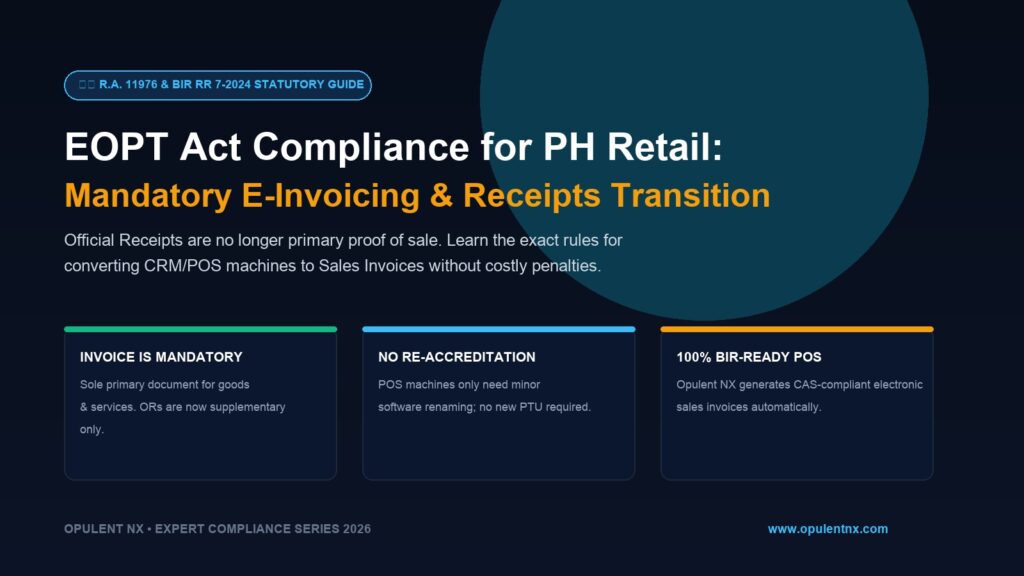
Under Republic Act No. 11976 (the Ease of Paying Taxes Act) and its primary tax implementing guidelines, BIR Revenue Regulations (RR) No. 7-2024, the commercial landscape for Philippine retail and service businesses underwent its most significant transformation in decades. Most crucially, the historical duality of issuing Official Receipts (OR) for services and Sales Invoices (SI) for goods has been completely abolished. Moving forward, the Invoice is now the sole primary commercial proof of sale for all transactions across the Philippines.
For supermarket operators, boutique retailers, restaurant franchisees, and growing multi-branch merchants, this statutory shift directly impacts your Point-of-Sale (POS) terminals, Cash Register Machines (CRM), and computerized accounting software. Operating outdated receipt configurations risks disallowance of input VAT for your commercial buyers and exposes your business to severe deficiency assessments under the National Internal Revenue Code (NIRC).
1. The Statutory Mandate: Abolition of Official Receipts as Primary Proof of Sale
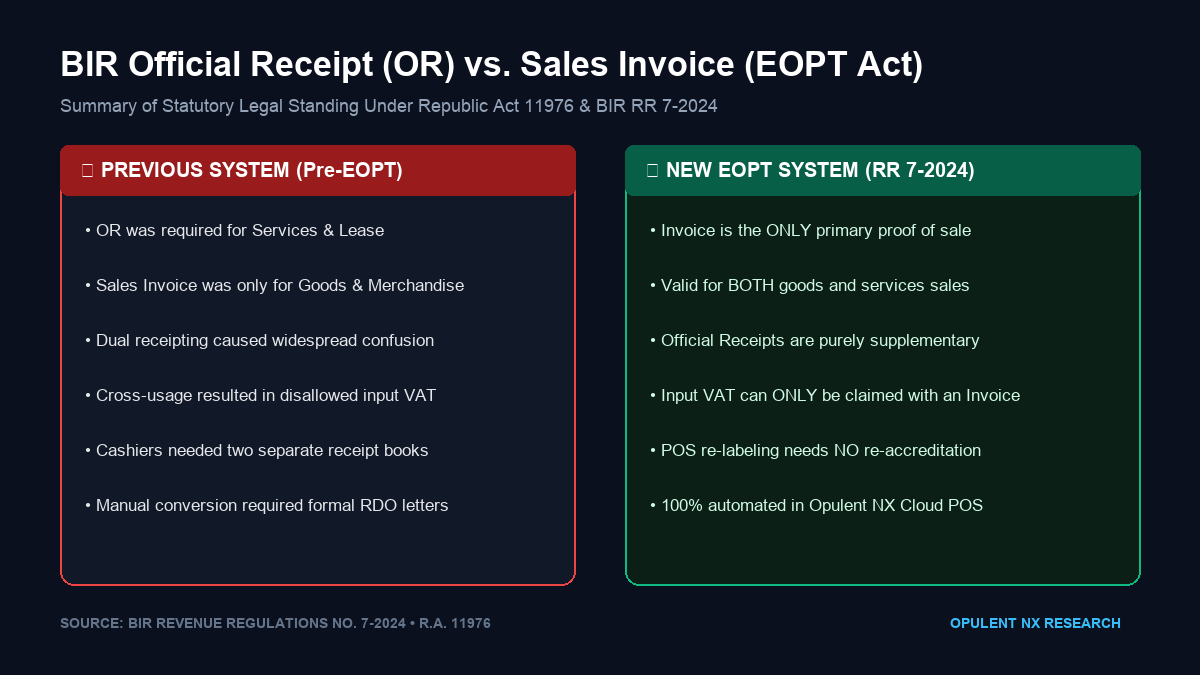
Prior to the enactment of the EOPT Act, Philippine tax practice maintained a strict, often litigious distinction between sellers of merchandise (who issued Sales Invoices) and sellers of services, leases, or professions (who issued Official Receipts). Cross-issuing the wrong document routinely led to disallowed input tax claims during BIR tax audits.
Section 8 of RR No. 7-2024 explicitly harmonizes all sales documentation:
- The Invoice is the Sole Primary Document: An invoice (including Sales Invoice, Commercial Invoice, Cash Invoice, Charge Invoice, or Service Invoice) must be issued at the point of each sale to substantiate the transaction and support input VAT claims.
- Official Receipts Relegated to Supplementary Documents: Official Receipts no longer prove the sale itself. They now function strictly as supplementary receipts—documenting the subsequent receipt of cash, collection of receivables, or evidence of payment. Supplementary documents cannot be used by buyers to claim input VAT.
- Input VAT Deductibility: Under amended Section 110 of the Tax Code, VAT-registered buyers can only deduct input tax if substantiated by a compliant, validly issued Invoice containing all mandatory statutory data fields.
2. How Retail POS Machines & Cash Registers Must Be Reconfigured
Many business owners mistakenly believed that the transition to invoices required scrapping their existing POS machines or reapplying for lengthy BIR accreditation. Fortunately, the Bureau of Internal Revenue clarified the exact operational mechanics for CRM, POS machines, and e-receipting software under RR No. 7-2024:
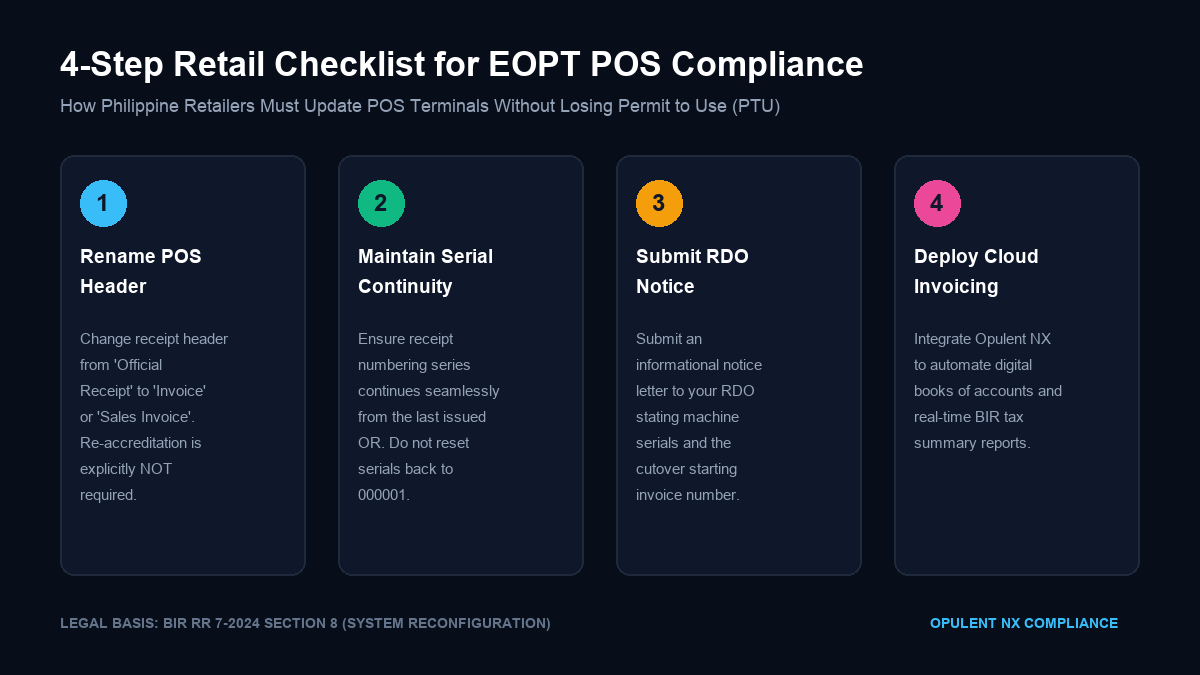
A. Simple Header Re-labeling (Minor System Enhancement)
Taxpayers utilizing POS machines or cash register machines are authorized to adjust their print templates from “Official Receipt” to “Invoice”, “Cash Invoice”, “Charge Invoice”, or “Service Invoice”. Under BIR guidelines, this software modification is formally categorized as a minor system enhancement.
Crucially, minor system enhancements do NOT require:
- Prior formal written approval or notice from the Revenue District Office (RDO) before initiating the change.
- Re-accreditation of the sales software by the POS software developer or vendor.
- Re-issuance of a new Permit to Use (PTU) for your registered POS machines.
B. Preservation of Machine Serial Number Continuity
When updating your POS software to print “Invoice” instead of “Official Receipt”, you must not reset your sequence back to number 000001. The invoice sequence must continue directly from the exact serial number following the last issued Official Receipt. For example, if your terminal issued Official Receipt #084920 yesterday, the first converted Invoice printed today must be numbered #084921.
C. Post-Reconfiguration RDO Notice
Within thirty (30) days following your system reconfiguration, your company must file a written informative notice with the respective RDO or Large Taxpayers Division having jurisdiction over the registered machine. This simple letter outlines the machine serial number (MIN), software version, and the starting invoice serial number.
3. Statutory Data Requirements on EOPT Sales Invoices
To ensure total validity during BIR audits and preserve your commercial customers’ right to claim input VAT, every POS-generated invoice must accurately display the following mandatory details:
| Invoice Element | Statutory BIR Requirement | Non-Compliance Risk |
|---|---|---|
| Document Title | Prominently titled “Invoice”, “Sales Invoice”, or “Cash Invoice” | Disallowed input tax if labeled as OR only |
| Seller Identification | Registered Business Name, Trade Name, Registered Address, and 9-digit TIN with 3-digit Branch Code (e.g. 000) | Fines under Section 264 of Tax Code |
| VAT Breakdown | Separate lines for Vatable Sales, VAT Amount (12%), VAT-Exempt Sales, and Zero-Rated Sales | Assessment of 12% output VAT on entire gross |
| Buyer’s Information | Mandatory Name, Address, and TIN for sales to VAT-registered businesses exceeding ₱1,000 | Customer unable to deduct input tax |
| Machine Accreditation Details | POS Machine Identification Number (MIN), Serial Number, and BIR Permit to Use (PTU) Date | ₱25,000 to ₱50,000 penalty per unregistered terminal |
4. Transitory Guidelines for Existing Manual Official Receipts
If your business still maintains stocks of unused manual or loose-leaf Official Receipts printed prior to the EOPT Act, you do not have to discard them immediately. BIR regulations provide two permitted pathways:
- Conversion to Invoices: You may stamp or cross-out the pre-printed term “Official Receipt” and boldly stamp “INVOICE” or “SALES INVOICE” on the document. These converted receipts can be issued as valid primary invoices until consumed, provided an inventory list of converted booklets was submitted to your RDO.
- Retention as Supplementary Documents: Alternatively, you may continue issuing unused ORs purely as acknowledgment of payment or collection receipts, provided every copy is clearly stamped:
“THIS DOCUMENT IS NOT VALID FOR CLAIM OF INPUT TAX.”
5. How Opulent NX Automates EOPT Invoicing & BIR Compliance
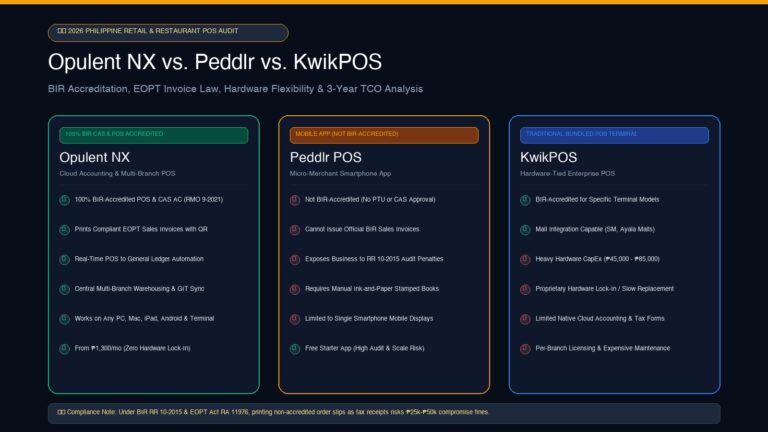
Manually adjusting receipt formats and keeping track of invoice numbering across multiple cashier lanes or branches introduces severe operational vulnerabilities. Opulent NX’s BIR-accredited POS and Cloud Accounting system provides 100% turnkey compliance with R.A. 11976 and RR 7-2024 right out of the box:
- Native EOPT Invoicing Engine: POS terminals instantly print BIR-compliant electronic sales invoices with automated 12% VAT, Zero-Rated, and Senior Citizen / PWD discount breakdowns.
- Dual Offline Cashier Resilience: Ring up sales, calculate taxes, and print invoices even during internet outages. Data automatically syncs to your central Philippine cloud ledger the instant connectivity is restored.
- Automated Books of Accounts: Every completed transaction directly populates your General Journal, Sales Journal, and Cash Receipts Journal in accordance with BIR Computerized Accounting System (CAS) standards.
- No Re-Accreditation Hassles: Complete software certification and PTU documentation support handled by our dedicated team of Philippine CPAs and compliance specialists.
Avoid compliance penalties and ensure your customers receive fully deductible sales invoices. Schedule a free live demo with Opulent NX today to see how our unified retail POS and cloud accounting platform streamlines your Philippine business operations.
See Opulent NX Live in Action
Book a free 15-minute walkthrough with our Philippine BIR & POS specialists. Start your 7-day free trial and see how we unify your cashier POS, inventory, and BIR accounting books.
- ✓ 100% BIR-Accredited POS & CAS / EOPT Compliant (From ₱1,300/mo)
- ✓ Real-Time POS to General Ledger & Multi-Warehouse Sync
- ✓ Free 7-Day Trial + 30-Min 1-on-1 Setup Call & PTU Assistance
Continue Reading: Related Philippine Compliance Guides

[…] Invoicing Integration: Conforms 100% with the new EOPT Act (R.A. 11976 / RR 7-2024), printing valid Sales Invoices that satisfy both RDO examiners and your accounting […]