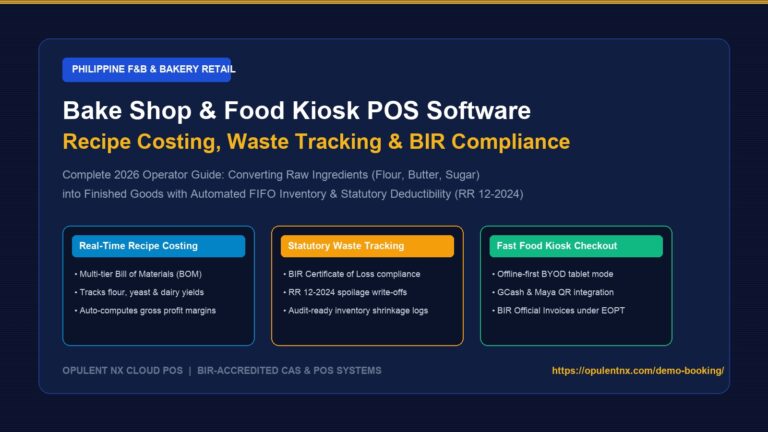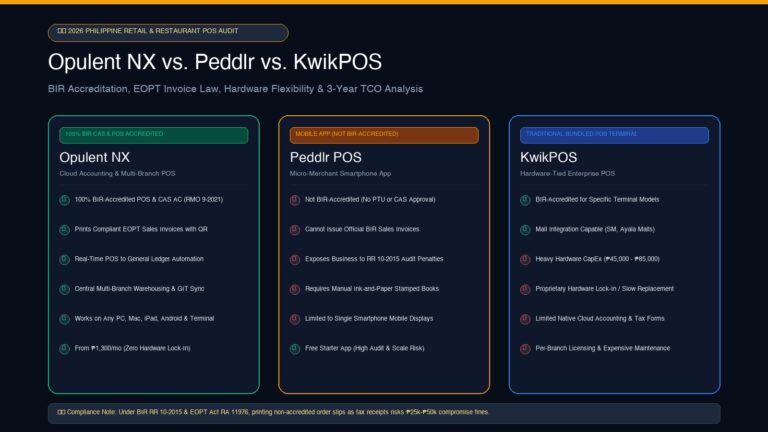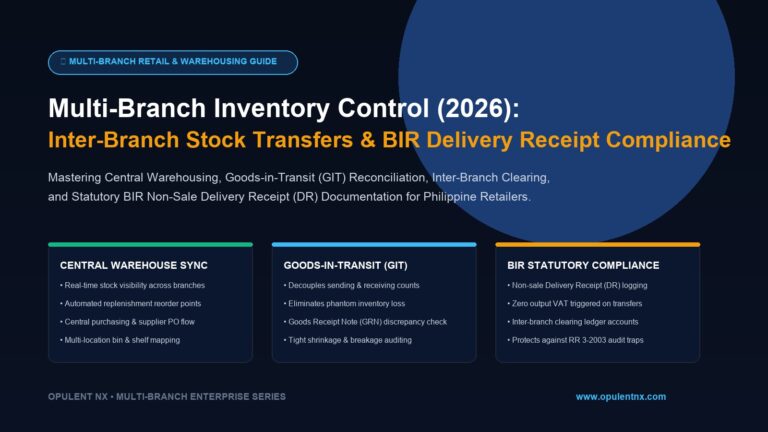

Senior Citizen (R.A. 9994) & PWD 20% Discount: BIR POS Computation Rules & Receipt Guide
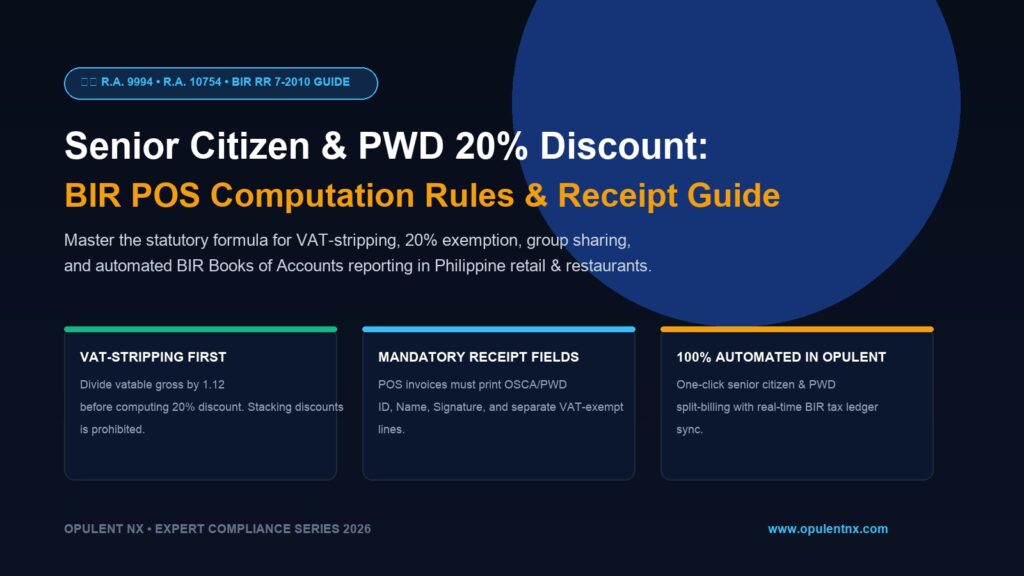
- 01The Statutory Rule: Why VAT Must Be Stripped Before Applying the 20% Discount
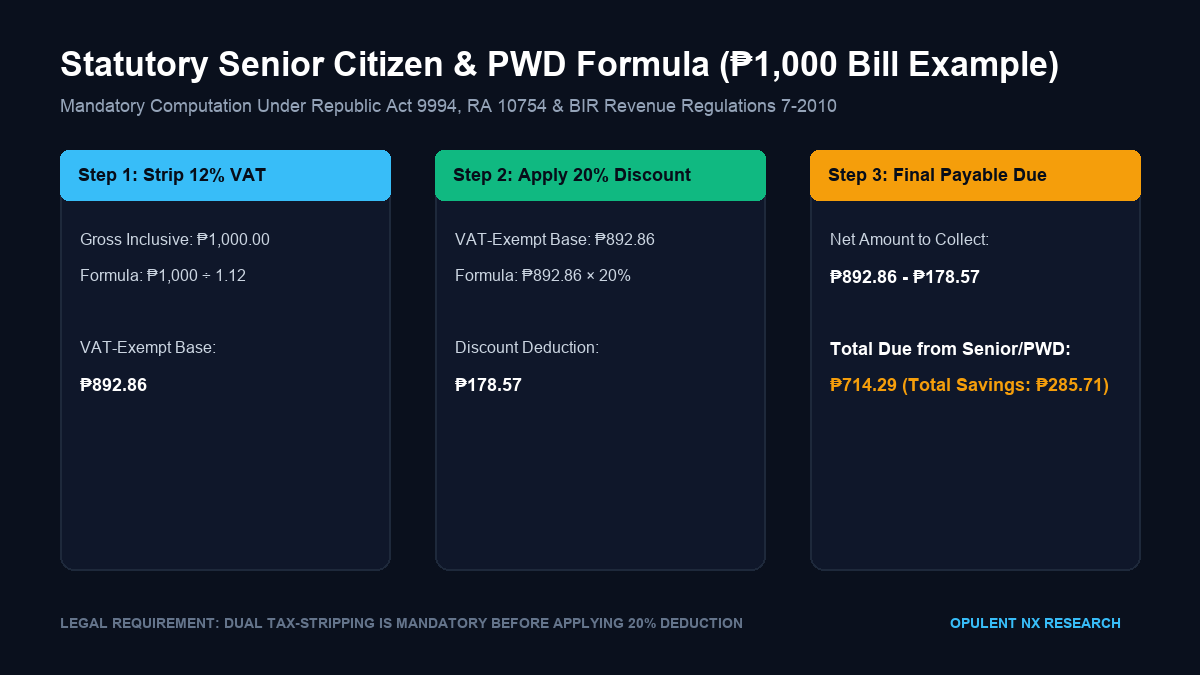
- 02Mathematical Breakdown: Step-by-Step ₱1,000 Purchase Example
- 03Group Meals & Pro-Rating: The “Sharing” Formula
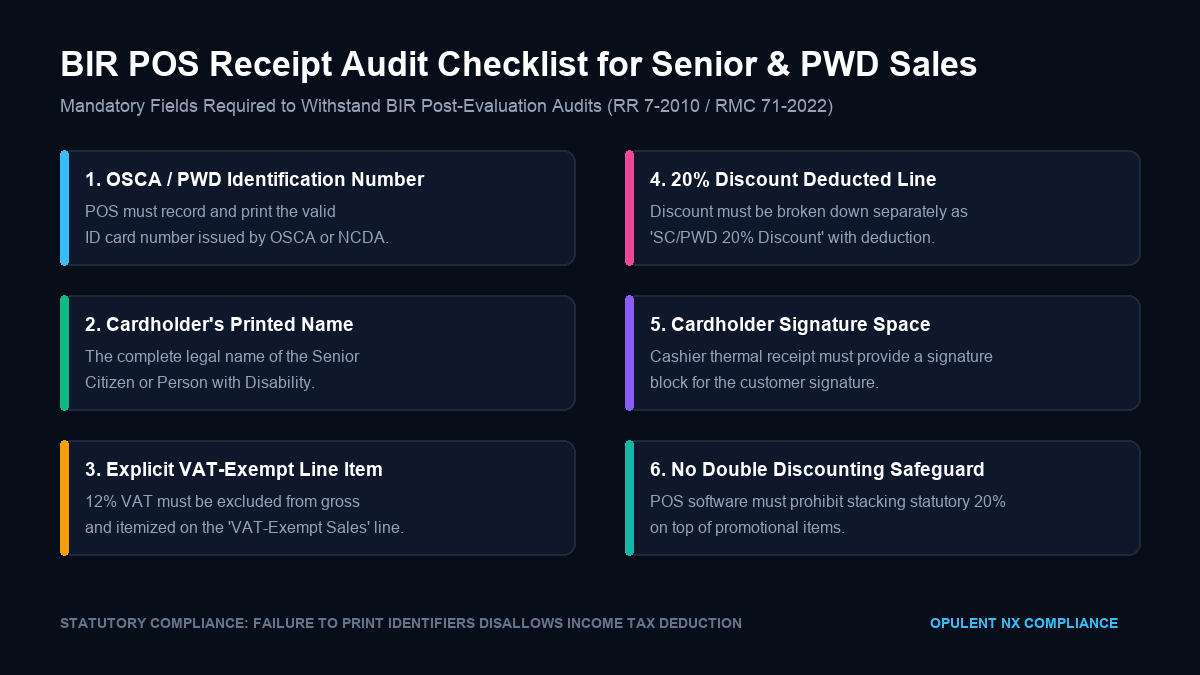
- 04Mandatory POS Receipt Elements Under BIR Audit Rules
- 05Crucial Statutory Rules: No Double Discounting & Dual-ID Holders
- 06How Opulent NX Automates Senior & PWD Compliance
Under Philippine tax and social legislation—specifically Republic Act No. 9994 (Expanded Senior Citizens Act of 2010), Republic Act No. 10754 (An Act Expanding the Benefits and Privileges of Persons with Disability), and BIR Revenue Regulations (RR) No. 7-2010—retailers, restaurants, pharmacies, and recreational establishments are legally mandated to grant a 20% discount and an exemption from the 12% Value-Added Tax (VAT) to qualified Senior Citizens and Persons with Disabilities (PWDs).
For Philippine business owners, cashiers, and accountants, calculating these privileges incorrectly creates serious financial and legal liabilities. Over-discounting eats into operating profit, while under-discounting or improperly formatting Point-of-Sale (POS) receipts violates statutory consumer rights and results in severe BIR deficiency tax assessments and disallowance of deductible business expenses during tax audits.
1. The Statutory Rule: Why VAT Must Be Stripped Before Applying the 20% Discount
The most pervasive mistake among Philippine retail cashiers and non-accredited POS software is applying the 20% discount directly onto the gross VAT-inclusive selling price. Section 10 of BIR RR No. 7-2010 explicitly stipulates that the 20% discount must be applied exclusively to the net-of-VAT amount.
Because Senior Citizens and PWDs are legally exempt from the 12% Value-Added Tax on covered purchases, applying a 20% discount onto a price that still bundles VAT leads to an erroneous double computation. The legal sequence requires two distinct mathematical steps:
- Step 1 (VAT Removal): Determine the VAT-exempt selling price by removing the 12% output VAT component from the gross price.
- Step 2 (20% Statutory Discount): Compute the 20% discount on that net VAT-exempt base.
- Step 3 (Final Amount Payable): Subtract the computed 20% discount from the net VAT-exempt base to arrive at the final collectible balance.
2. Mathematical Breakdown: Step-by-Step ₱1,000 Purchase Example
To illustrate the exact arithmetic executed by a BIR-accredited POS system, consider a senior citizen purchasing a ₱1,000.00 meal at a VAT-registered dining establishment:
| Step | Formula & Mathematical Calculation | Amount (PHP) |
|---|---|---|
| Menu Price (Gross Inclusive of 12% VAT) | Original selling price posted on menu or shelf tag | ₱1,000.00 |
| Less: 12% Output VAT Component | ₱1,000.00 - (₱1,000.00 ÷ 1.12) = ₱1,000.00 – ₱892.86 |
(₱107.14) |
| VAT-Exempt Base Price | ₱1,000.00 ÷ 1.12 |
₱892.86 |
| Less: 20% Senior Citizen / PWD Discount | ₱892.86 × 20% |
(₱178.57) |
| Total Net Amount Due from Customer | ₱892.86 - ₱178.57 |
₱714.29 |
Total Customer Benefit: The eligible patron saves a total of ₱285.71 (₱107.14 in VAT exemption + ₱178.57 in statutory discount), representing an effective savings of 28.57% off the original menu price.
3. Group Meals & Pro-Rating: The “Sharing” Formula
One of the most contentious operational scenarios in Philippine food service involves a group dining together where only one or two diners are Senior Citizens or PWDs. How should a POS cashier calculate the allowable discount?
Under BIR Ruling No. 176-2011 and DTI-DSWD joint guidelines, restaurants cannot apply the 20% discount to the entirety of a shared group meal. Instead, the POS must execute pro-rated consumption splitting:
- Individual Consumption: If items ordered were consumed exclusively by the Senior/PWD (e.g. personal solo entrée and drink), the discount applies 100% to those specific items.
- Shared / Group Meals (Platters, Buckets, Family Sizes): When food is shared among $N$ individuals, the total bill must be divided by the total headcount ($N$), and the 20% discount + VAT exemption is applied only to the proportionate share ($1/N$) consumed by the qualified cardholder.
For instance, if a family of 4 dines on a ₱4,000 shared group meal, and one member is a Senior Citizen: the senior’s pro-rated share is ₱1,000 (₱4,000 ÷ 4). The discount is calculated on that ₱1,000 share (₱714.29 payable for the senior), while the remaining ₱3,000 is billed normally with standard 12% VAT.
4. Mandatory POS Receipt Elements Under BIR Audit Rules
To substantiate the 20% discount as a deductible expense on your annual Income Tax Return (BIR Form 1702-RT) and avoid output VAT assessments, your POS machine must record and print specific data fields on each sales invoice:
- Identification Card Details: The printed invoice must display the cardholder’s complete name and valid OSCA ID number (Office for Senior Citizens Affairs) or NCDA PWD ID number.
- VAT Classification Breakdown: The thermal receipt must cleanly isolate:
- VATable Sales: ₱0.00 (for the senior’s portion)
- VAT-Exempt Sales: Full net base amount
- 12% VAT Amount: ₱0.00 (for the senior’s portion)
- SC / PWD Discount Amount: Explicitly broken out as a negative line item
- Customer Signature Block: The invoice must include dedicated printed lines for the patron’s signature to verify personal attendance and consumption.
5. Crucial Statutory Rules: No Double Discounting & Dual-ID Holders
Cashier teams must be trained on two critical statutory boundaries:
A. The Prohibition Against “Double Discounting”
Under Section 5 of R.A. 9994, if a store or restaurant offers a promotional markdown, coupon, or discounted combo meal, the qualified patron can choose either the promotional price OR the statutory 20% Senior/PWD discount, whichever is higher or more favorable. The cashier cannot stack both discounts together unless the merchant voluntarily opts to extend both.
B. Dual-ID Holders (Senior Citizens with Disability)
A customer who is both a Senior Citizen and a Person with Disability is entitled to claim the 20% privilege under only one statutory status per transaction. A dual-ID holder cannot demand a 40% discount on the same item.
6. How Opulent NX Automates Senior & PWD Compliance
Managing split bills, manual VAT subtraction, and customer ID recordkeeping at a crowded retail checkout counter causes cashier bottlenecks and arithmetic errors. Opulent NX’s BIR-accredited POS and Cloud Accounting system completely automates compliance:
- One-Click Senior & PWD Split Billing: Cashiers simply tap the “Senior/PWD” button, enter the headcount and card number, and the POS instantly recalculates VAT-exempt lines and discounts down to the exact centavo.
- Automated BIR Deduction Ledger: Every granted discount is logged directly into your General Ledger as an allowable promotional/tax deduction, fully backed by serialized audit trail records.
- EOPT Invoicing Integration: Conforms 100% with the new EOPT Act (R.A. 11976 / RR 7-2024), printing valid Sales Invoices that satisfy both RDO examiners and your accounting team.
Streamline your cashier checkout lines while staying 100% compliant with Philippine tax law. Book a free live demo with Opulent NX today to experience automated retail and restaurant point-of-sale accounting.
See Opulent NX Live in Action
Book a free 15-minute walkthrough with our Philippine BIR & POS specialists. Start your 7-day free trial and see how we unify your cashier POS, inventory, and BIR accounting books.
- ✓ 100% BIR-Accredited POS & CAS / EOPT Compliant (From ₱1,300/mo)
- ✓ Real-Time POS to General Ledger & Multi-Warehouse Sync
- ✓ Free 7-Day Trial + 30-Min 1-on-1 Setup Call & PTU Assistance
Continue Reading: Related Philippine Compliance Guides