
How to Transition from Manual Books of Accounts to BIR CAS Without Penalties (RMO 9-2021 Guide)
- 01The Regulatory Shift: How RMO 9-2021 Streamlined CAS Adoption
- 02The 4-Stage Roadmap to a Penalty-Free CAS Migration
- 03Manual Books vs. Loose-Leaf vs. Computerized Accounting System (CAS)
- 04Severe Risks of Transitioning Without BIR Acknowledgement
- 05How Opulent NX Makes CAS Transition Turnkey and Risk-Free
For thousands of micro, small, and medium enterprises (MSMEs) in the Philippines, recording business transactions in traditional columnar ledger notebooks with blue or black ink is no longer feasible. Growing retail transaction volumes, multi-branch operations, and the e-invoicing provisions under the Ease of Paying Taxes (EOPT) Act (Republic Act No. 11976) have rendered manual bookkeeping an operational bottleneck and an audit liability.
However, migrating away from manual journals to a Computerized Accounting System (CAS) or Computerized Books of Accounts (CBA) requires strict procedural discipline. Simply downloading software and abruptly abandoning your stamped manual books is an administrative offense under the National Internal Revenue Code (NIRC). Doing so exposes your business to compromise penalties ranging from ₱25,000 to ₱50,000 for “failure to maintain registered books of accounts,” and worse—the risk that BIR revenue officers disregard your digital financial statements entirely during an audit examination.
1. The Regulatory Shift: How RMO 9-2021 Streamlined CAS Adoption
Historically, securing permission from the Bureau of Internal Revenue to adopt accounting software was one of the most bureaucratic processes in Philippine business. Under legacy rules (RR 9-2009), taxpayers were forced to undergo months of software evaluations, Technical Working Group (TWG) presentations, and live code demonstrations before securing a formal Permit to Use (PTU).
In adherence to the Ease of Doing Business and Efficient Government Service Delivery Act (RA 11032), the BIR enacted Revenue Memorandum Order (RMO) No. 9-2021, supplemented by Revenue Memorandum Circular (RMC) No. 5-2021, fundamentally reforming the transition process:
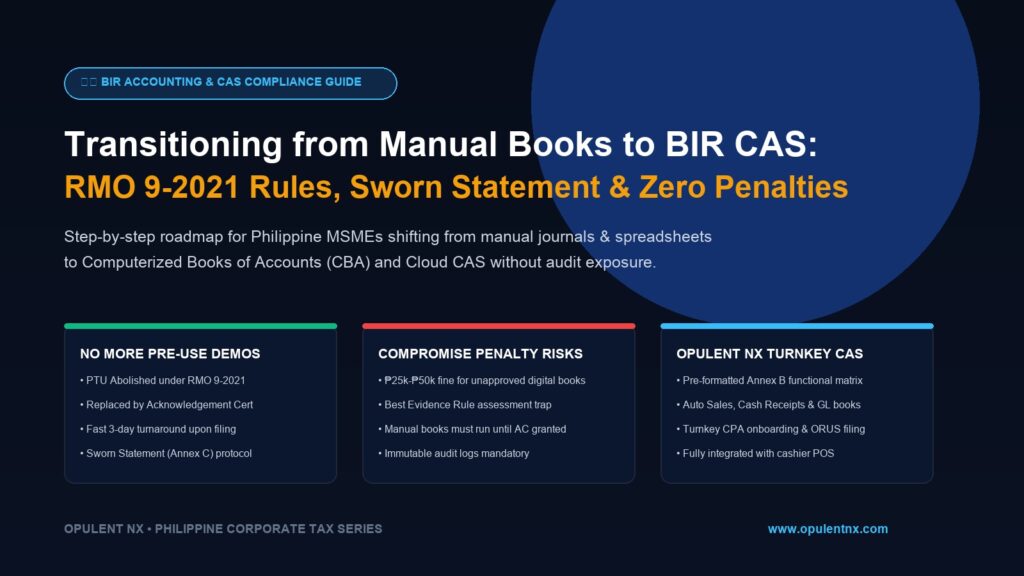
- Abolition of the CAS Permit to Use (PTU): The requirement to obtain a prior PTU for new CAS applications was completely revoked. Software demonstrations prior to live implementation are no longer conducted.
- The Acknowledgement Certificate (AC) Standard: In place of the PTU, the BIR now issues an Acknowledgement Certificate (AC) upon receipt of complete documentary requirements.
- Fast-Track 3-Day Turnaround: Revenue District Offices (RDOs) and the Large Taxpayers Assistance Division (LTAD) are mandated to issue the AC within three (3) working days from the date of complete submission.
- Post-Evaluation & Sworn Statement Mechanism: Taxpayers and accredited software vendors submit a formal Sworn Statement attesting that the system satisfies statutory audit trail and record-keeping standards. Verification is performed post-deployment during regular BIR tax audits.
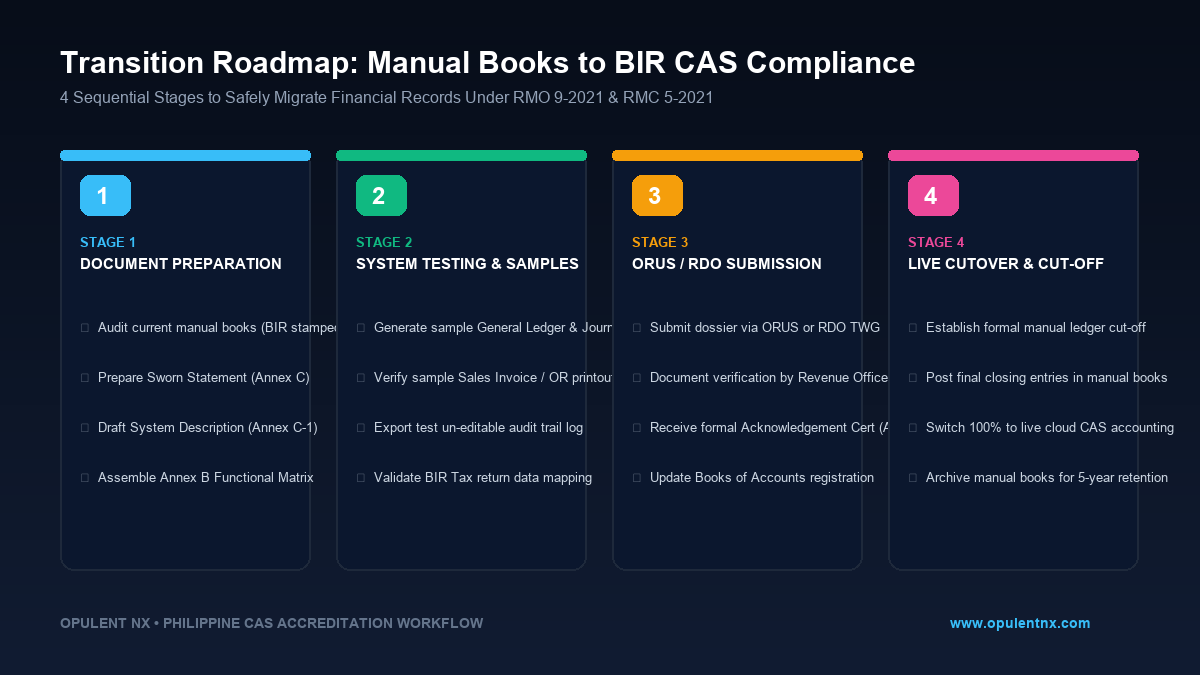
2. The 4-Stage Roadmap to a Penalty-Free CAS Migration
To safely transition your enterprise to digital bookkeeping without attracting BIR compromise penalties, execute this 4-stage operational roadmap:
Stage 1: Document Preparation & Vendor Certification
Before touching your live financial records, assemble the standardized statutory application dossier:
- Sworn Statement (Annex “C” of RMO 9-2021): A notarized declaration executed by the taxpayer (or Joint Sworn Statement with your software vendor) attesting to system capabilities and internal controls.
- Summary of System Description & Specifications (Annex “C-1”): Complete technical specifications outlining database structures, security protocols, user permissions, and backup routines.
- Standard Functional & Technical Requirements Matrix (Annex “B”): A detailed matrix certifying that the software produces standard General Ledgers, Subsidiary Ledgers, Sales Journals, Purchase Journals, and Cash Receipts Books with tamper-resistant audit logs.
Stage 2: Sample Printouts & System Validation
Your RDO requires physical test printouts generated by the software to verify statutory layout compliance:
- Sample printouts of the General Journal, Sales Journal, Cash Receipts Book, and General Ledger showing proper debit and credit balancing.
- Sample of the unified Sales Invoice reflecting mandatory tax breakdown fields (VATable Sales, VAT-Exempt Sales, Zero-Rated Sales, 12% Output VAT) under the EOPT Act.
- A printed sample of the System Audit Trail demonstrating that transaction voids, modifications, and user login timestamps are permanently preserved.
Stage 3: Submission via ORUS or Revenue District Office
- Submit the complete application dossier electronically through the BIR ORUS Portal or submit hard copies directly to the TWG desk at your jurisdictional RDO.
- Upon document validation, the RDO issues your official Acknowledgement Certificate (AC) containing your unique CAS Registration Number.
- Update your BIR Form 2303 registration profile to reflect Computerized Books of Accounts.
Stage 4: The Clean Cut-Off & Archival Protocol
The single most dangerous mistake businesses make is stopping manual bookkeeping halfway through a tax period without establishing a clean cut-off:
- Do NOT stop manual entries prematurely: Continue updating your manual or loose-leaf books until the exact date your Acknowledgement Certificate is issued.
- Post Closing Entries in Manual Books: On the cutover date, rule and close your manual journals. Enter the final balances in ink, post closing entries, and write: “Closed on [Date] pursuant to BIR Acknowledgement Certificate No. [AC Number] for Computerized Accounting System.”
- Archive Manual Books: Keep your closed manual ledgers on site for five (5) years in compliance with Section 235 of the NIRC.
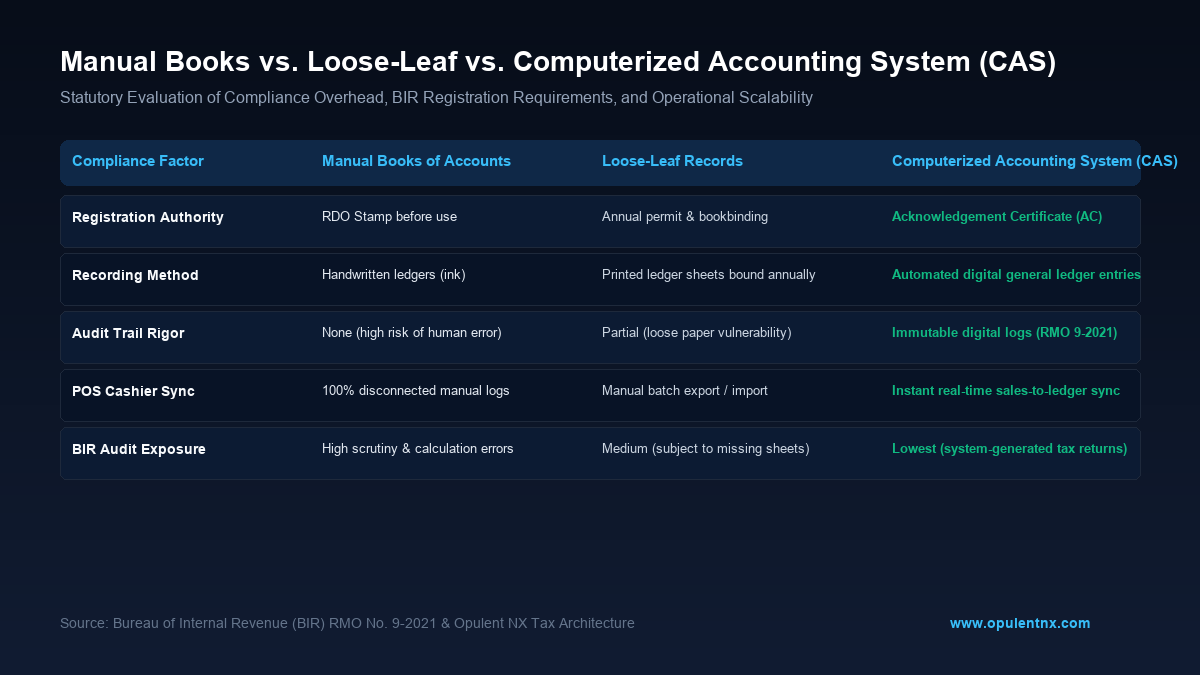
3. Manual Books vs. Loose-Leaf vs. Computerized Accounting System (CAS)
The following matrix compares the three recognized record-keeping methods under Philippine tax law:
| Compliance Parameter | Manual Books | Loose-Leaf Records | Computerized Accounting System (CAS) |
|---|---|---|---|
| Registration Document | Physical RDO stamp on notebook cover | Permit to Use Loose-Leaf + Annual Bookbinding | Acknowledgement Certificate (AC) under RMO 9-2021 |
| Data Entry Overhead | 100% manual handwriting in ink | Spreadsheet typing + periodic manual printing | 100% automated from cashier POS & invoices |
| Audit Trail Integrity | None (Vulnerable to unrecorded entries) | Low (Sheets can be replaced or misplaced) | Immutable digital audit trails with user logs |
| Annual Filing Obligation | None until pages are exhausted | Mandatory hard-bound printing within 15 days of year-end | Digital submission / backup DVD/USB or Cloud Retention |
| Audit Scrutiny & Exposure | Highest (Calculation errors & legibility issues) | Medium (Missing bound volume penalties) | Lowest (Standardized, balanced financial statements) |
4. Severe Risks of Transitioning Without BIR Acknowledgement
Some business owners believe that using cloud accounting software “quietly” in the background while keeping old manual books in a drawer is safe. This creates severe legal exposure under BIR scrutiny:
- The “Failure to Maintain Books” Penalty: Section 275 of the NIRC imposes fines of up to ₱50,000 for maintaining unauthorized or unapproved accounting systems.
- Disregard of Digital Records (Best Evidence Rule): If the BIR discovers unaccredited accounting software, revenue examiners have the authority to throw out your digital reports entirely and assess your taxes using arbitrary industry averages—often resulting in millions of pesos in arbitrary deficiency tax assessments.
- Double Bookkeeping Criminal Penalties: Maintaining two conflicting sets of financial records (one manual for tax inspectors and one computerized for actual management) is classified as intentional tax evasion under Section 257 of the NIRC, carrying severe criminal penalties.
5. How Opulent NX Makes CAS Transition Turnkey and Risk-Free
Most Philippine MSMEs delay CAS adoption because preparing the Annex B technical matrix, system descriptions, and sworn statements seems daunting.
Opulent NX eliminates transition friction with pre-certified statutory packages:
- Pre-Engineered Annex B Matrix & System Specs: Our software documentation is already formatted to RMO 9-2021 specifications, ready for immediate ORUS submission.
- Turnkey CPA Onboarding Assistance: Our Makati-based CPA team assists in preparing your Sworn Statements, sample journal outputs, and cutover protocols.
- Native Cashier POS to General Ledger Integration: When cashiers ring up sales on Opulent NX BIR-Accredited POS, General Ledger entries, Sales Journals, and Inventory COGS update automatically in real time.
- Flat, Predictable Pricing: Full CAS accounting and POS capabilities starting from just ₱1,300/month, with zero per-transaction cuts or surprise renewal fees.
Eliminate manual ledger headaches and protect your business against BIR audit penalties. Schedule a free 15-minute consultation with our Philippine BIR CAS specialists today.
See Opulent NX Live in Action
Book a free 15-minute walkthrough with our Philippine BIR & POS specialists. Start your 7-day free trial and see how we unify your cashier POS, inventory, and BIR accounting books.
- ✓ 100% BIR-Accredited POS & CAS / EOPT Compliant (From ₱1,300/mo)
- ✓ Real-Time POS to General Ledger & Multi-Warehouse Sync
- ✓ Free 7-Day Trial + 30-Min 1-on-1 Setup Call & PTU Assistance
Continue Reading: Related Philippine Compliance Guides