
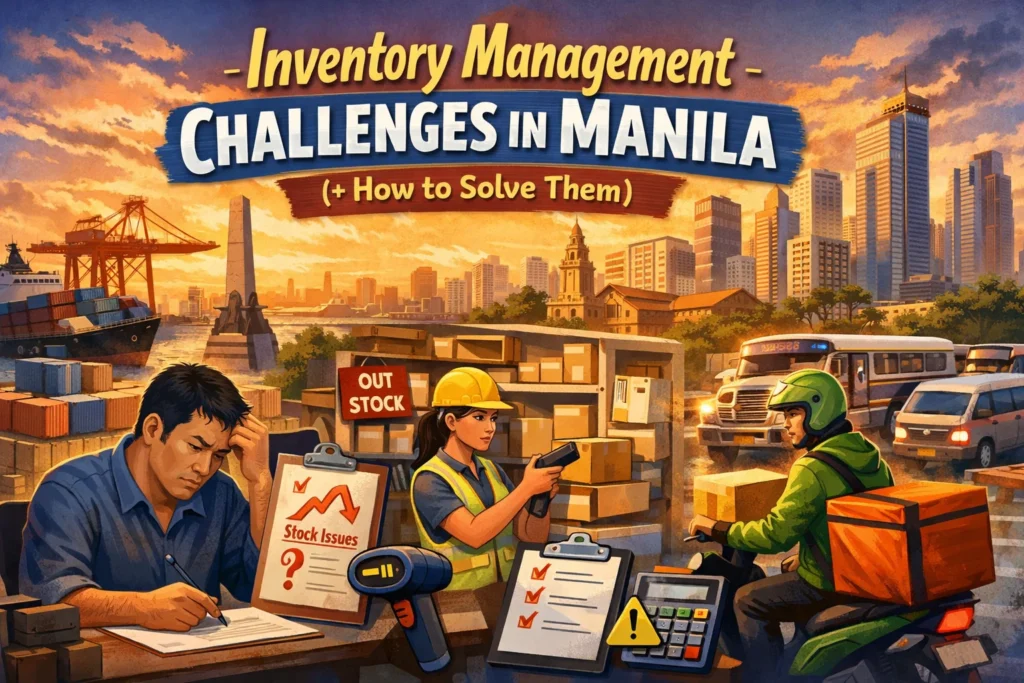
Inventory Management Challenges in Manila (+ How to Solve Them)
Last updated on April 7th, 2026 at 05:13 am
Managing inventory in Manila is not just about tracking stock—it’s about dealing with constant uncertainty.
From traffic delays affecting deliveries to sudden spikes in customer demand, businesses across Metro Manila face operational challenges that make traditional inventory management methods unreliable.
Many retailers and distributors struggle with:
- Running out of fast-moving products during peak demand
- Overstocking slow-moving items that tie up cash flow
- Making decisions based on delayed or inaccurate stock data
These problems are not caused by poor planning alone—they are the result of Manila’s unique business environment, where logistics, demand patterns, and space constraints constantly shift.
This guide explores the real inventory management challenges in the Philippines, with a focus on Manila, and provides practical strategies businesses can use to improve efficiency, reduce losses, and gain better control over their operations.
Understanding Inventory Management in the Manila Business Environment
Inventory management is the process of tracking, organizing, and controlling stock to ensure the right products are available at the right time.
However, in Manila, inventory management is not just a backend operation—it is a critical business function shaped by local conditions.
Unlike more stable markets, businesses in Metro Manila must manage inventory while dealing with:
- Unpredictable delivery schedules due to traffic congestion
- Limited storage capacity caused by high rental costs
- Rapid changes in customer demand influenced by seasons, events, and pay cycles
Because of this, inventory management in the Philippines requires a more adaptive approach—one that goes beyond simple stock tracking.
Why Inventory Management Works Differently in Manila
In many countries, inventory systems rely on consistent patterns:
- Stable supplier lead times
- Predictable customer demand
- Sufficient storage space
But Manila presents a different reality.
For example:
- A delivery scheduled for 2 hours may take an entire day
- Demand for certain products can double during payday weekends
- Retailers often operate with minimal backroom storage
This means businesses must constantly balance:
- Availability (avoiding stockouts)
- Efficiency (avoiding overstocking)
- Flexibility (responding to sudden changes)
The Gap Between Traditional Methods and Real Conditions
Traditional inventory methods—such as manual tracking or fixed reorder levels—assume stability.
But in Manila:
- Lead times are inconsistent
- Demand is highly dynamic
- Operational disruptions are common
👉 This creates a gap between how inventory is managed and how it should be managed.
As a result, many businesses experience:
- Frequent stock shortages
- Excess inventory costs
- Poor visibility into actual stock levels
Setting the Foundation for Better Inventory Decisions
To manage inventory effectively in Manila, businesses need to:
- Understand the local factors affecting stock movement
- Use data instead of assumptions
- Adapt processes to real-world conditions
This is why modern approaches focus not just on tracking inventory—but on understanding the environment in which inventory operates.
Key Inventory Management Challenges in Manila Businesses
Inventory management in Manila is shaped by a combination of logistical, economic, and behavioral factors. These challenges are interconnected, making it difficult for businesses to maintain accurate stock levels and consistent operations.
Understanding these challenges is essential for improving efficiency and avoiding costly inventory mistakes.
1. Unpredictable Delivery Times Due to Traffic Congestion
Traffic congestion across Metro Manila disrupts even the most carefully planned supply schedules.
Deliveries that should follow fixed timelines often become inconsistent due to delays on major routes.
Impact:
- Variable lead times instead of predictable schedules
- Difficulty setting accurate reorder points
- Increased risk of stockouts for fast-moving products
This makes traditional inventory planning—based on average delivery times—unreliable in real conditions.
2. Limited Storage Space and High Rental Costs
Retail and warehouse space in Manila is expensive and often limited, especially in high-demand business areas.
Businesses must operate within tight space constraints while managing a wide range of products.
Impact:
- Inability to maintain sufficient safety stock
- Higher costs associated with overstocking
- Slow-moving items occupying valuable storage space
This creates a constant trade-off between stock availability and cost efficiency.
3. Rapid and Unpredictable Demand Fluctuations
Customer demand in Manila is highly dynamic and influenced by multiple external factors:
- Weather changes
- Payday cycles
- Holidays and local events
Impact:
- Sudden spikes in demand for specific products
- Overstocking of items with declining demand
- Difficulty maintaining balanced inventory levels
Without proper planning, businesses are forced into reactive decision-making.
4. Disconnected Sales Channels and Inventory Data
Many businesses operate across multiple sales channels, including physical stores, online platforms, and social media.
Without centralized tracking:
Impact:
- Inconsistent inventory records
- Overselling due to delayed updates
- Increased manual errors
This lack of synchronization reduces visibility and affects overall control.
5. Compliance and Documentation Complexity
This includes tracking stock movement and maintaining proper documentation.
Impact:
- Increased administrative workload
- Higher risk of manual errors
- Potential compliance issues
Manual systems often make this process inefficient and error-prone.
How These Challenges Interconnect
These challenges do not exist in isolation.
For example:
- Delivery delays affect reorder timing
- Limited storage reduces flexibility in stocking
- Demand fluctuations increase pressure on forecasting
As a result, small disruptions can quickly escalate into larger operational problems.
Why Traditional Inventory Methods Break Down
Manual tracking and fixed planning models assume stable conditions—but Manila operates in constant variability.
This leads to:
- Delayed and inaccurate decision-making
- Poor visibility into stock levels
- Inefficient use of capital
To overcome these issues, businesses need more adaptive and structured approaches to inventory management.
How Manila Businesses Can Solve Inventory Management Challenges
Once businesses understand the key inventory challenges in Manila, the next step is applying practical strategies to overcome them.
Instead of relying on fixed methods, businesses need to adopt approaches that are flexible, data-driven, and aligned with real operating conditions.
Use Data-Driven Reorder Planning
In Manila, fixed reorder levels often fail due to unpredictable delivery times.
A better approach is to base reorder decisions on:
- Actual sales trends
- Maximum supplier lead time
- A flexible safety stock buffer
Why this works:
- Reduces the risk of stockouts during delays
- Improves accuracy in restocking decisions
- Aligns inventory levels with real demand patterns
Focus on High-Impact Products
Not all products contribute equally to revenue.
Businesses should prioritize:
- Fast-moving items
- High-demand products
- Items with consistent sales patterns
Benefits:
- Better use of limited storage space
- Improved stock availability for key products
- Reduced effort on low-impact inventory
Plan Inventory Around Demand Patterns
Demand in Manila follows recurring patterns influenced by:
- Payday cycles
- Seasonal changes
- Holidays and events
Strategy:
- Increase stock before peak periods
- Adjust purchasing based on past trends
- Reduce exposure to slow-moving products
This helps businesses move from reactive decisions to planned inventory management.
Maintain Flexible Safety Stock Levels
Because of uncertainty in supply and demand, safety stock should not be fixed.
Businesses should:
- Increase safety stock during high-risk periods
- Reduce excess stock when demand stabilizes
- Continuously adjust based on performance data
Result:
A better balance between availability and cost control.
Centralize Inventory Visibility
When inventory data is spread across multiple systems or channels, accuracy suffers.
Businesses should aim to:
- Maintain a single view of all inventory
- Track stock movements consistently
- Reduce manual updates
Outcome:
- Fewer errors
- Better decision-making
- Improved operational control
Reduce Risk by Diversifying Suppliers
Depending on a single supplier increases vulnerability to delays and disruptions.
A better approach is to:
- Work with multiple suppliers for key products
- Monitor supplier reliability
- Keep backup options available
Benefit:
Greater stability in supply and fewer disruptions.
Moving from Reactive to Structured Inventory Management
Many businesses struggle because they react to problems after they occur.
By applying these strategies, businesses can:
- Anticipate demand and supply changes
- Maintain consistent stock levels
- Reduce operational inefficiencies
This shift allows inventory management to become more structured, predictable, and aligned with business growth.
The Role of Technology in Modern Inventory Management in Manila
As inventory challenges in Manila become more complex, manual processes and disconnected systems are no longer enough to maintain accuracy and control.
While strategies like demand planning and safety stock adjustments are essential, they are difficult to execute consistently without the support of technology.
Modern inventory solutions help businesses move from reactive decision-making to real-time, data-driven control.
Why Manual Inventory Management Falls Short
Many businesses still rely on spreadsheets or manual tracking.
In a fast-moving environment like Manila, this creates several limitations:
- Delayed updates that do not reflect actual stock levels
- Higher risk of human error
- Lack of visibility across multiple locations or sales channels
- Difficulty responding quickly to demand or supply changes
Result:
Decisions are often based on outdated or incomplete information.
How Technology Improves Inventory Visibility
Technology enables businesses to track inventory in real time.
This means:
- Stock levels update instantly as sales occur
- Inventory movements are recorded accurately
- Businesses can monitor stock across all locations
Impact:
- Better stock control
- Faster response to demand changes
- Reduced discrepancies
Using Data to Improve Inventory Decisions
Modern systems provide insights based on actual business data.
This helps businesses understand:
- Which products sell fastest
- When demand increases or declines
- How inventory trends change over time
Benefit:
More accurate forecasting and smarter purchasing decisions.
Automating Reorder and Stock Alerts
Instead of manually checking stock levels, businesses can rely on automated alerts.
These systems notify when:
- Stock reaches critical levels
- Reordering is required
- Demand patterns shift
Result:
- Fewer stockouts
- Reduced manual workload
- More timely replenishment decisions
Centralizing Inventory Across Multiple Channels
For businesses selling through physical stores, e-commerce, or social platforms, technology creates a unified inventory system.
This ensures:
- Consistent stock data across all channels
- Reduced risk of overselling
- Better coordination between operations
Technology as a Support System for Growth
The value of technology is not just automation—it is consistency and scalability.
With the right system, businesses can:
- Apply inventory strategies more effectively
- Maintain accuracy as operations grow
- Reduce dependency on manual processes
This allows inventory management to become more structured and reliable, even in a complex market like Manila.
Bridging Strategy and Execution
At this stage, the gap becomes clear:
- Strategies define what needs to be done
- Technology ensures it is done consistently
For Manila businesses, combining both is essential to maintaining control and improving efficiency.
How to Choose the Right Inventory Solution for Your Manila Business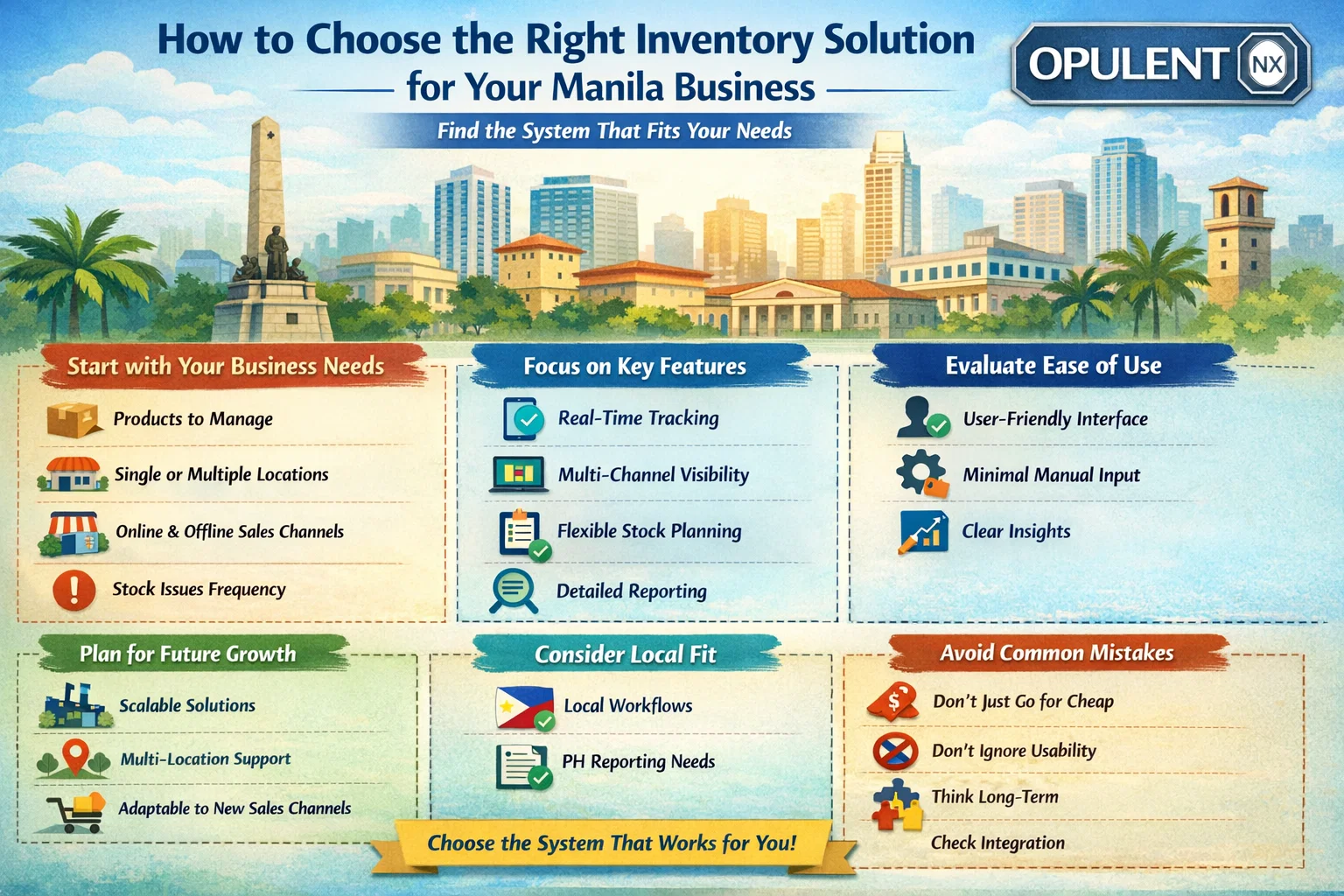
After understanding the challenges, strategies, and role of technology in inventory management, the next step is selecting a solution that aligns with your business operations.
For Manila businesses, the focus should not be on choosing the most popular system—but on selecting one that fits real operational needs and local conditions.
Start with Your Business Requirements
Before evaluating any solution, clearly define:
- The number of products you manage
- Whether you operate from one location or multiple branches
- Your sales channels (offline, online, or both)
- The frequency of stock-related issues
Why this matters:
Choosing a system without clarity often results in:
- Paying for unnecessary features
- Using a system that cannot support growth
Focus on Features That Solve Real Problems
Instead of looking at long feature lists, prioritize capabilities that address Manila-specific challenges:
- Accurate, real-time inventory updates
- Visibility across all sales channels
- Support for flexible stock planning
- Reliable reporting and tracking
Key insight:
A system is only valuable if it directly solves your operational problems.
Evaluate Ease of Use and Team Adoption
A system should simplify your workflow—not complicate it.
Look for solutions that:
- Are easy to understand and use
- Require minimal manual input
- Provide clear and actionable data
Why this matters:
Even the best system will fail if your team cannot use it consistently.
Plan for Future Growth
As your business expands, your inventory operations will become more complex.
Choose a solution that can:
- Handle increasing product volume
- Support multiple locations
- Adapt to additional sales channels
Goal:
Avoid switching systems later, which can disrupt operations.
Consider Local Compatibility
For businesses in the Philippines, local alignment is important.
Your solution should fit:
- Local business workflows
- Reporting and documentation needs
- Day-to-day operational realities
Benefit:
Smoother implementation and fewer adjustments over time.
Avoid Common Mistakes
Many businesses make decisions based on the wrong priorities.
Common mistakes include:
- Choosing based only on price
- Ignoring usability
- Overlooking long-term scalability
- Failing to consider integration with existing processes
Avoiding these ensures your system delivers consistent value.
Making a Practical and Sustainable Choice
The right inventory solution is not the most complex—it is the one that:
- Matches your business size and operations
- Solves your current inventory challenges
- Supports long-term growth
For Manila businesses, adaptability and reliability matter more than unnecessary complexity.
Preparing for Implementation
Once you have selected the right solution, the next step is applying it effectively within your operations.
👉 In the final section, we’ll summarize key insights and outline how to take the next step toward improving your inventory management process.
Final Thoughts: Solving Inventory Challenges in Manila
Inventory management in Manila requires more than basic tracking—it demands adaptability, accuracy, and a clear understanding of local business conditions.
With unpredictable delivery timelines, fluctuating demand, and limited storage capacity, businesses must move beyond traditional methods and adopt a more structured approach.
What Sets Successful Manila Businesses Apart
Businesses that manage inventory effectively in Manila focus on:
- Using data to guide inventory decisions
- Adapting to changing demand and supply conditions
- Maintaining clear visibility across all stock movements
- Applying consistent processes to reduce errors
These practices help transform inventory from a daily challenge into a controlled and optimized operation.
Turning Inventory Management into an Advantage
When inventory is managed properly, it directly contributes to:
- Better product availability
- Improved cash flow
- Reduced operational inefficiencies
- Stronger ability to scale
Instead of reacting to problems, businesses can operate with more confidence and stability.
Taking the Next Step
If your business is experiencing issues such as stockouts, overstocking, or lack of visibility, the first step is to evaluate:
- Where inventory inaccuracies occur
- How demand patterns affect your stock
- Whether your current processes can handle growth
Improving these areas creates a foundation for more efficient operations.
👉 Ready to Improve Your Inventory Management?
If you’re looking for a more structured and reliable way to manage inventory in the Philippines, consider using a solution designed to handle real-world business challenges in Manila.
👉 Explore inventory management software here: inventory-management-software
