
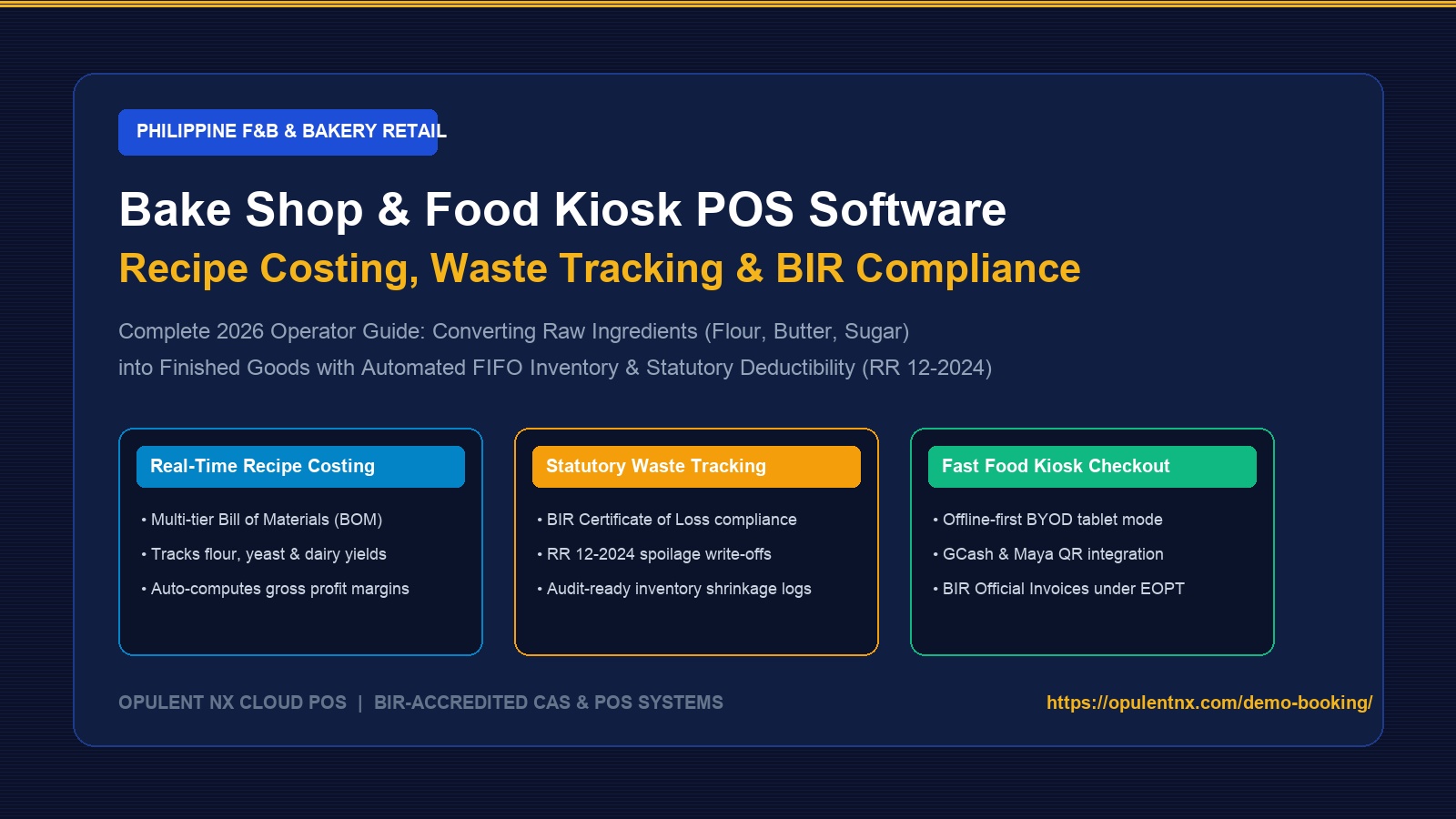
Bake Shop and Food Kiosk POS Software: Recipe Costing, Waste Tracking and BIR Compliance (2026 Guide)
- 01The Economics of Bakery Operations: Why Retail POS Systems Fail
- 02Recipe Costing Architecture: Multi-Tier Bill of Materials (BOM)
- 03Statutory Waste Tracking: BIR Spoilage Deductibility under RR 12-2024
- 04Food Kiosk Checkout Workflows: Speed, Mobility & EOPT Invoicing
- 05Ease of Paying Taxes (EOPT) Act Compliance for Bakery Retailers
- 06Multi-Branch Production & Commissary Distribution
- 07Selecting the Ideal POS System for Your Bakery Enterprise
Operating a profitable bake shop, patisserie, or commercial food kiosk in the Philippines requires balancing raw ingredient micro-economics against strict Bureau of Internal Revenue (BIR) statutory recordkeeping. While typical retail environments simply decrement unit barcodes at the point of sale, commercial bakeries and F&B kiosks convert bulk commodity ingredients—such as sacks of first-class flour, blocks of butter, refined sugar, and active yeast—into multi-item finished pastries, custom cakes, and ready-to-drink beverages.
Without an integrated Bill of Materials (BOM) and recipe costing engine tied directly to a BIR-accredited Point of Sale (POS) and Computerized Accounting System (CAS), food operators suffer from two fatal vulnerabilities: unmonitored ingredient leakage that destroys gross margins, and disallowed tax deductions for perishable spoilage under BIR Revenue Regulations.
This comprehensive operational guide details how Philippine bakery chains, single-branch bake shops, and franchise food kiosks maintain live recipe costing, automate food waste write-offs under BIR RR 12-2024, and remain fully compliant with the Ease of Paying Taxes (EOPT) Act (Republic Act No. 11976).
The Economics of Bakery Operations: Why Retail POS Systems Fail
Off-the-shelf retail POS software assumes a static one-to-one relationship between inventory purchases and checkout sales: buying 100 bottled sodas and selling 100 bottled sodas. In a bakery or food kiosk, this model collapses immediately:
- Raw Material Conversions: Buying a 25-kilogram sack of flour produces dozens of disparate SKUs, from artisanal sourdough loaves and pan de sal to Danish pastries and cookies.
- Batch Yield Variations: Ambient humidity, proofing temperature, and baking evaporation create variable yields from identical raw ingredient inputs.
- Sub-Recipe Dependencies: Professional bakeries operate on intermediate sub-assemblies (e.g., butter cream frosting, chocolate ganache, laminated dough blocks) that are produced in advance and used across multiple finished products.
- High Perishability & Spoilage: Fresh baked goods carry a shelf life of 24 to 72 hours. Unsold items represent real cash losses that must be formally recorded to satisfy tax authorities and preserve financial integrity.
When food entrepreneurs attempt to track bakery operations on generic retail cash registers or mobile apps lacking BOM capabilities, they are forced into manual Excel variance reconciliation. This creates operational blind spots where raw material theft, over-portioning, and unrecorded kitchen waste can drain 8% to 15% of annual revenues.
Recipe Costing Architecture: Multi-Tier Bill of Materials (BOM)
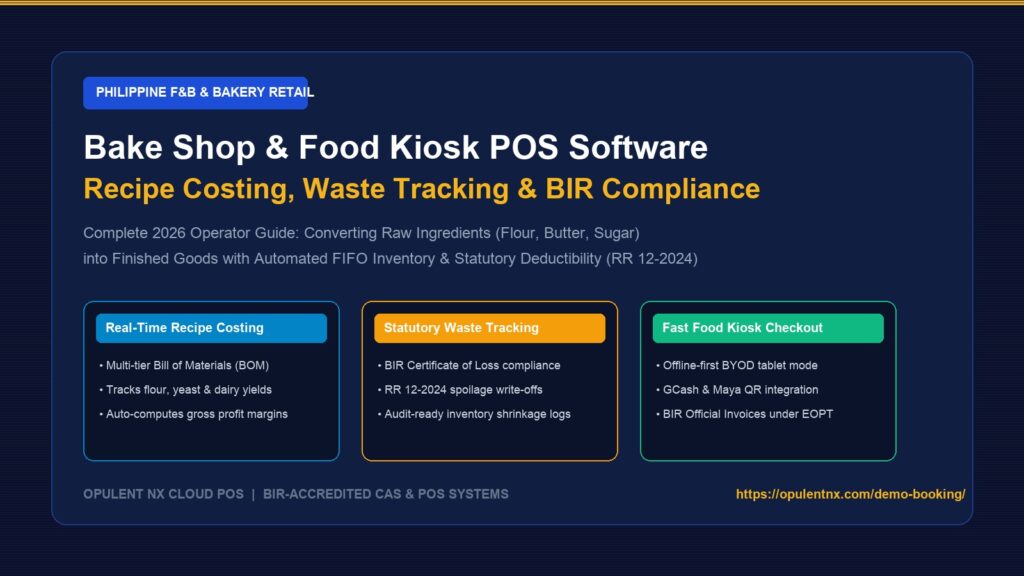
A cloud-native F&B point of sale solves inventory disparity by establishing a strict Bill of Materials (BOM) hierarchy. When a cashier rings up a single pastry or a kiosk combo meal, the backend POS engine automatically debits the precise gram-weight of underlying ingredients from raw material stock in real time.
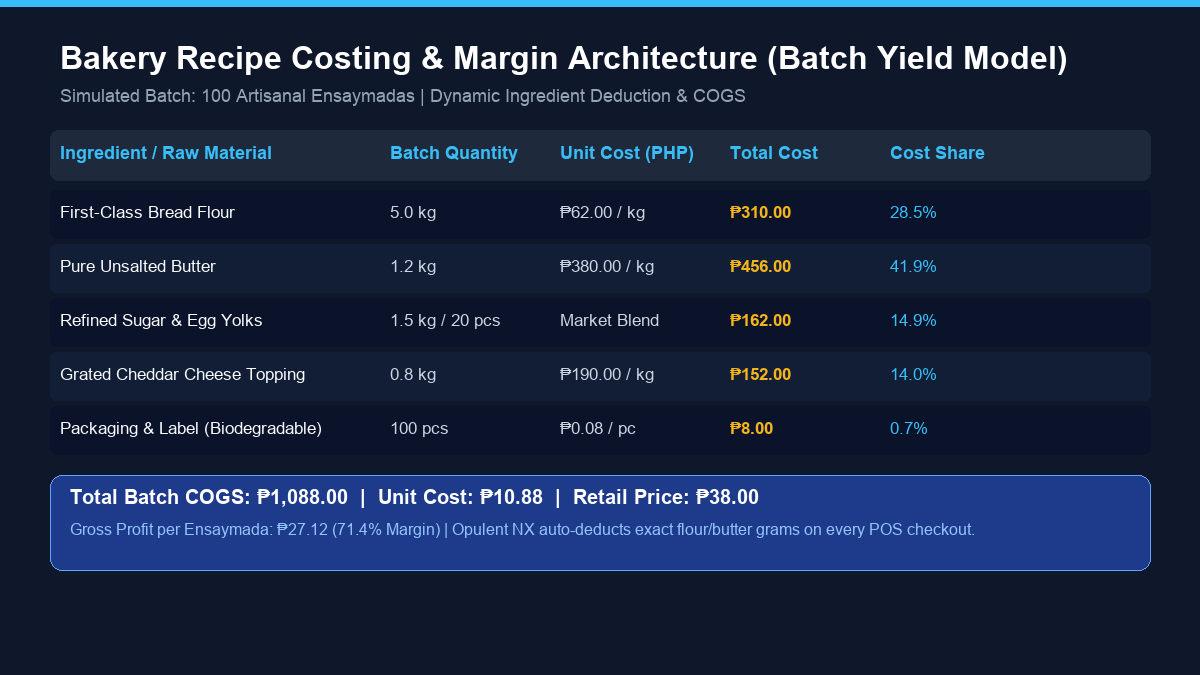
Consider the real-world cost matrix of an artisanal ensaymada batch produced in a commercial kitchen:
| Raw Material Input | Batch Quantity (100 pcs) | Unit Cost (PHP) | Batch Cost | Cost Share |
|---|---|---|---|---|
| First-Class Bread Flour | 5.0 kg | ₱62.00 / kg | ₱310.00 | 28.5% |
| Pure Unsalted Dairy Butter | 1.2 kg | ₱380.00 / kg | ₱456.00 | 41.9% |
| Refined Sugar & Egg Yolks | 1.5 kg / 20 pcs | Market Blend | ₱162.00 | 14.9% |
| Grated Aged Cheddar Cheese | 0.8 kg | ₱190.00 / kg | ₱152.00 | 14.0% |
| Biodegradable Packaging & Seal | 100 pcs | ₱0.08 / pc | ₱8.00 | 0.7% |
| Total Cost of Goods Sold (COGS) per 100-pc Batch | ₱1,088.00 (₱10.88 / unit) | |||
At a retail price of ₱38.00 per pastry, the business earns ₱27.12 in gross profit per unit (a 71.4% gross margin). However, if ingredient suppliers increase the price of dairy butter by 15%, the POS system immediately recalculates unit COGS to ₱11.56, alerting kitchen management to either adjust batch retail pricing or re-engineer ingredient ratios before cash flow is impacted.
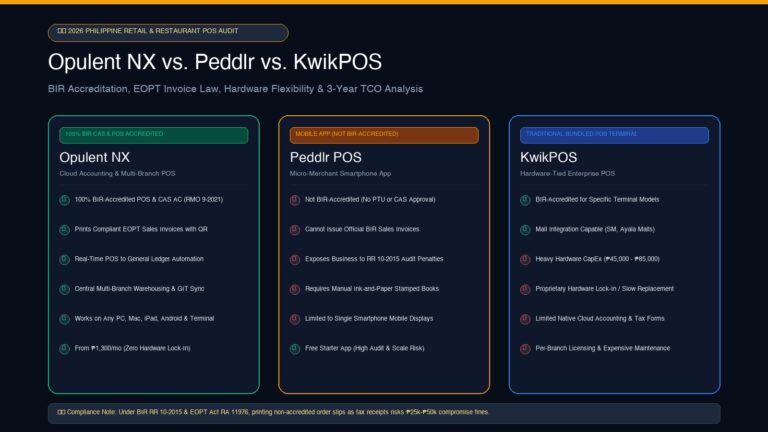
To explore how automated BOM pricing integrates into enterprise business tiers, review our comprehensive breakdown of BIR-accredited POS and accounting software pricing models.
Statutory Waste Tracking: BIR Spoilage Deductibility under RR 12-2024
One of the most dangerous audit traps for Philippine food businesses is informal waste logging. In day-to-day operations, kitchen staff throw away day-old bread, cracked eggs, or burnt crusts without formal documentation. At the end of the fiscal year, accountants write off these inventory shortages under “Cost of Goods Sold” or “Operating Losses.”
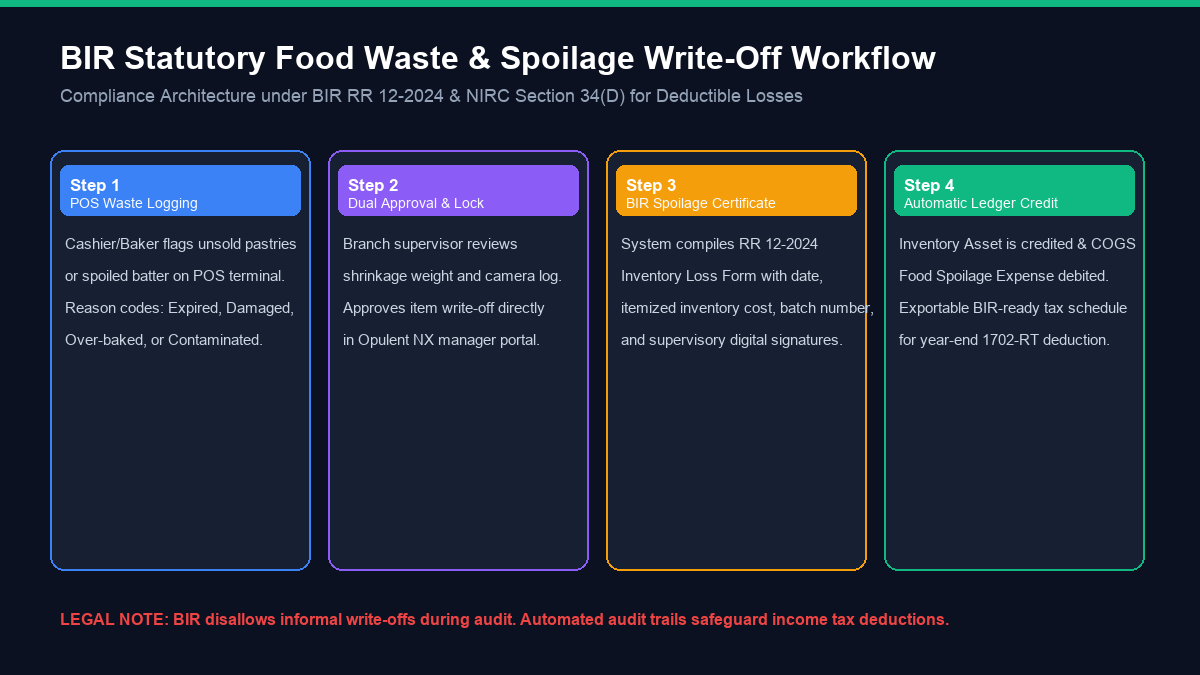
Under Section 34(D) of the National Internal Revenue Code (NIRC) and updated procedures under BIR Revenue Regulations No. 12-2024, the BIR strictly disallows tax deductions for inventory spoilage, expired goods, or shrinkage unless supported by empirical, audit-ready verification.
Statutory Requirements for Food Loss Deductions
To claim food waste as an allowable deductible business expense on BIR Form 1702-RT (Corporate Income Tax Return), the business must maintain:
- Granular Shrinkage Logs: The POS must record the exact date, time, SKU, batch number, unit cost, and specific reason code (e.g., Expired, Mold/Damage, Over-baked, Spilled, Trimmings).
- Dual-Authorization Digital Signature: Terminal operators must submit waste write-offs through supervisory approval to prevent cashier collusion or shrinkage concealment.
- BIR Inventory Loss Certificate: The software must compile periodic inventory discrepancy schedules cross-referenced with physical count sheets and kitchen waste records.
- Accounting Journal Automation: The loss must be properly credited against the Inventory Asset Account and debited to Loss on Inventory Spoilage / Shrinkage (an expense account) rather than buried into standard sales volume.
Failure to provide digital audit logs during a BIR Letter of Authority (LOA) tax audit results in the disallowance of claimed losses, retroactively triggering a 25% surcharge, 12% annual deficiency interest, and compromise penalties.
Food Kiosk Checkout Workflows: Speed, Mobility & EOPT Invoicing
Food kiosks located in shopping malls, transit hubs, and commercial centers face distinct hardware and environmental constraints compared to sit-down restaurants. With high foot traffic and tight footprint limitations (often 4 to 8 square meters), kiosks cannot deploy bulky legacy POS towers.
BYOD Android Tablet Architecture
Modern F&B operators utilize cloud-native Bring-Your-Own-Device (BYOD) setups: commercial Android tablets or sleek all-in-one touch terminals paired with 58mm or 80mm thermal receipt printers and Bluetooth barcode/QR scanners. For multi-terminal hardware pricing comparisons, consult our guide to commercial POS machines and hardware setups in the Philippines.
Offline-First Operational Continuity
Mall kiosks frequently suffer from unstable Wi-Fi or cellular data dead zones. Opulent NX’s cloud-native architecture operates on an offline-first local database cache. Cashiers can continue ringing up customer orders, printing official receipts, and calculating Senior Citizen / PWD discounts without active internet connectivity. Once the connection is re-established, the POS silently synchronizes transactional logs to the central cloud ledger without double-posting.
Integrated Digital Payment QR Codes
With cash transactions declining across metropolitan retail, kiosk terminals must dynamically generate Philippine National Standard QR codes (QR Ph) for instant settlement via GCash, Maya, and major Philippine banking apps. Opulent NX records the external reference number directly into the fiscal sales payload, eliminating manual end-of-day reconciliation discrepancies.
Ease of Paying Taxes (EOPT) Act Compliance for Bakery Retailers
Following the enactment of Republic Act No. 11976 (Ease of Paying Taxes Act) and its implementing regulations (RR No. 7-2024 and RR No. 26-2025), the statutory framework governing sales documentation in the Philippines has fundamentally evolved:
- The Primacy of the Official Invoice: The historical distinction between “Sales Invoices” for goods and “Official Receipts” for services has been harmonized. All bakery retail sales are formally documented using a unified Official Invoice.
- Mandatory Customer Data Thresholds: For retail purchases of ₱500.00 or more, or whenever requested by a VAT-registered commercial customer (such as corporate catering clients), the POS must capture and print the customer’s Registered Business Name, Taxpayer Identification Number (TIN), Address, and Business Style.
- Strict VAT Breakdown Display: Receipts must display total gross sales, VAT-exempt sales (such as agricultural inputs or raw bread), VATable sales, 12% output tax, and applicable statutory discounts (such as 20% Senior Citizen and PWD discounts under R.A. 9994).
To verify the statutory accreditation differences between temporary machine permits and full enterprise compliance, review our in-depth analysis on BIR Permit to Use (PTU) vs. CAS Acknowledgement Certificates.
Multi-Branch Production & Commissary Distribution
Growing bakery enterprises typically scale from a single storefront to a centralized commissary kitchen feeding multiple satellite kiosks. This business model requires real-time Inter-Branch Stock Transfers (IBST):
Commissary to Satellite Kiosk Workflow
1. Production Batching: The central commissary produces 500 loaves of bread and 1,000 pastries, automatically deducting raw flour, sugar, and yeast from warehouse stock.
2. Delivery Receipt (DR) Generation: A serialized BIR-compliant Delivery Receipt is issued at the warehouse gate to accompany the delivery van in transit.
3. Destination Receiving: The kiosk cashier scans or confirms the incoming delivery on the POS terminal. Stock is immediately transferred from “Goods-in-Transit” into active kiosk inventory without manual re-encoding.
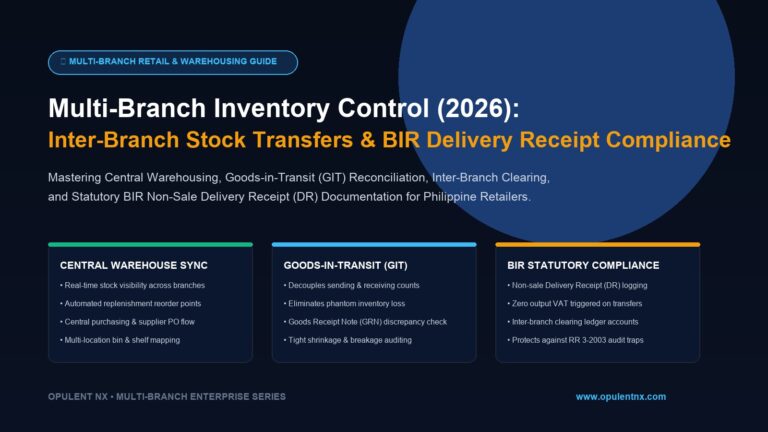
For complete regulatory guidelines on intra-company goods transfers, see our technical breakdown of multi-branch inventory control and BIR delivery receipt compliance.
Selecting the Ideal POS System for Your Bakery Enterprise
When evaluating Point of Sale and inventory platforms for Philippine bakery and food kiosk operations, business owners should use this executive evaluation checklist:
- ✓ True Bill of Materials (BOM): Does the system support fractional gram-level recipe breakdown and multi-tier sub-recipes?
- ✓ Statutory Spoilage Logging: Does the software generate audit-ready inventory shrinkage forms complying with BIR RR 12-2024?
- ✓ Full EOPT Compliance: Does the POS issue unified Official Invoices and maintain required customer VAT data fields?
- ✓ Offline-First Reliability: Can cashiers continue processing customer queues during unexpected mall internet blackouts?
- ✓ Unified Cloud Accounting: Does point-of-sale data automatically feed real-time general ledger journals without third-party connector fees?
Opulent NX delivers a purpose-built F&B and retail point of sale engineered specifically for the Philippine statutory environment. From fractional raw material costing to automated BIR loss schedules, Opulent NX protects your operating margins while eliminating audit exposure.
Transform Your Bakery Margins with Opulent NX
Eliminate kitchen ingredient leakage, automate statutory waste write-offs, and deploy fast, BIR-compliant kiosk checkout terminals across all branches.
See Opulent NX Live in Action
Book a free 15-minute walkthrough with our Philippine BIR & POS specialists. Start your 7-day free trial and see how we unify your cashier POS, inventory, and BIR accounting books.
- ✓ 100% BIR-Accredited POS & CAS / EOPT Compliant (From ₱1,300/mo)
- ✓ Real-Time POS to General Ledger & Multi-Warehouse Sync
- ✓ Free 7-Day Trial + 30-Min 1-on-1 Setup Call & PTU Assistance
Continue Reading: Related Philippine Compliance Guides