

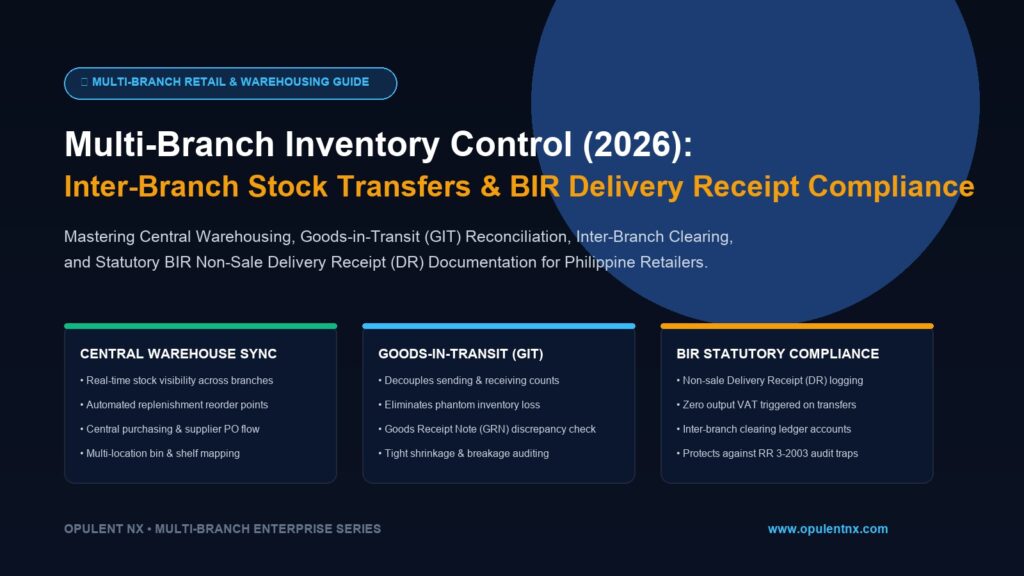
Multi-Branch Inventory Control: Inter-Branch Stock Transfers & BIR Delivery Receipt Compliance (2026 Guide)
- 01The Tax Distinction: Commercial Sales Invoice vs. Inter-Branch Delivery Receipt
- 02The 4-Stage Inter-Branch Transfer & GIT Lifecycle
- 03Key Compliance Benchmarks: Sales Invoice vs. Inter-Branch Transfer
- 04Operational Best Practices to Prevent Multi-Branch Shrinkage
- 05How Opulent NX Powers Multi-Branch Philippine Retailers
Scaling a retail business, supermarket chain, or multi-outlet franchise from a single store to multiple locations across Metro Manila and provincial hubs is the ultimate test of supply chain resilience. In a multi-branch enterprise, physical inventory is your largest capital asset—and your greatest source of financial leakage if branch stock levels are tracked on disconnected point-of-sale terminals and manual spreadsheets.
When stock moves between branches or from a central commissary warehouse to retail store shelves, business owners must navigate two critical challenges: inventory visibility to prevent stockouts and phantom losses, and statutory tax compliance under the Bureau of Internal Revenue (BIR). Misclassifying an internal stock transfer as a commercial sale triggers unearned output VAT liabilities, while moving goods without proper Delivery Receipts (DR) exposes your company’s logistics vehicles to confiscation and severe audit penalties.
1. The Tax Distinction: Commercial Sales Invoice vs. Inter-Branch Delivery Receipt
One of the most widespread compliance mistakes among growing Philippine retail chains is confusion over what documentation must accompany inventory moving between company-owned branches:
- Is an Inter-Branch Transfer a Taxable Sale? No. Under Philippine tax jurisprudence and the National Internal Revenue Code (NIRC), an internal transfer of goods between branches belonging to the same legal entity (same Taxpayer Identification Number) is a physical relocation of assets, not a sale, barter, or exchange. Consequently, no output Value-Added Tax (VAT) is triggered, and a primary BIR Sales Invoice must never be issued.
- The Mandatory Role of the Delivery Receipt (DR): Under BIR regulations (including RR No. 18-2012 and EOPT Act provisions), all goods in transit on public highways must be accompanied by an official, BIR-registered Delivery Receipt (DR), Delivery Order, or Transfer Manifest. This secondary document serves as legal proof of ownership and origin during roadside inspections by local authorities or BIR tax enforcement checkpoints.
- Required Document Notation: To prevent BIR revenue officers from mistakenly treating an inventory movement as an unrecorded commercial sale during a tax audit, all transfer slips must explicitly display the prominent watermark or header: “FOR INTER-BRANCH STOCK TRANSFER ONLY – NOT A BIR SALES INVOICE”.
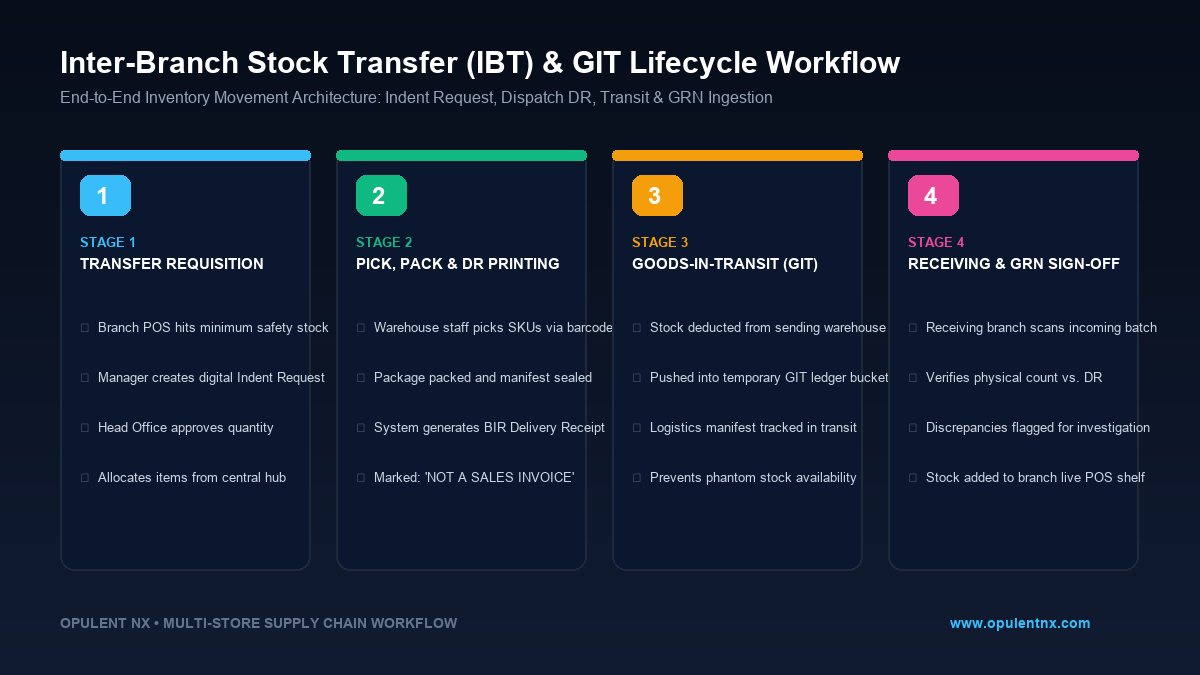
2. The 4-Stage Inter-Branch Transfer & GIT Lifecycle
To eliminate inventory shrinkage, prevent theft during transit, and ensure total financial auditability, progressive multi-branch retailers implement a structured 4-stage transfer protocol:
Stage 1: Digital Indent Requisition & Head Office Approval
Stock movements should never occur via informal phone calls, text messages, or verbal requests:
- When an individual store’s on-hand quantity drops below its minimum safety stock threshold, the store manager submits a digital Stock Transfer Request (Indent) through the cloud ERP system.
- The Head Office inventory controller reviews real-time stock balances across all locations, determining whether to fulfill the request from the central distribution warehouse or initiate an inter-branch rebalance from a slow-moving store nearby.
Stage 2: Barcode Picking, Packing & Delivery Receipt Generation
Once approved, the dispatch warehouse prepares the items for transport:
- Warehouse personnel scan the outgoing product barcodes using handheld scanners, verifying the exact SKU, batch/lot number, and quantity.
- The system automatically generates a numbered BIR Delivery Receipt recording the sending branch RDO code, destination branch address, driver details, truck plate number, and dispatch timestamp.
- The transfer cartons are sealed with tamper-evident security tape corresponding to the manifest number.
Stage 3: Goods-in-Transit (GIT) Accounting Decoupling
The single greatest operational flaw in basic POS systems is deducting stock from Branch A and immediately adding it to Branch B the instant the driver leaves. If the truck breaks down or items are damaged, phantom inventory appears on store shelves:
- In an enterprise architecture like Opulent NX, the moment goods are dispatched, they are deducted from the sending location and placed into a dedicated Goods-in-Transit (GIT) virtual holding warehouse.
- In the general ledger, the system posts an internal clearing entry: Debit Goods-in-Transit | Credit Inventory (Sending Warehouse) at moving average cost.
- Neither branch can sell the items while they are physically on the road, eliminating overselling and cashier confusion.
Stage 4: Receiving Verification & Goods Receipt Note (GRN) Sign-Off
When the delivery arrives at the destination store, strict receiving protocols must be enforced:
- The receiving supervisor must perform a “blind count” or scan each incoming barcode against the digital Delivery Receipt before acknowledging acceptance.
- If discrepancies exist (e.g., 95 units received vs. 100 dispatched), the system logs a Discrepancy Variance Report, crediting 95 units to the store’s sellable stock and routing the 5 missing units to an investigation queue for logistics liability.
- The final Goods Receipt Note (GRN) automatically closes the GIT ledger entry, posting: Debit Inventory (Receiving Branch) | Credit Goods-in-Transit.
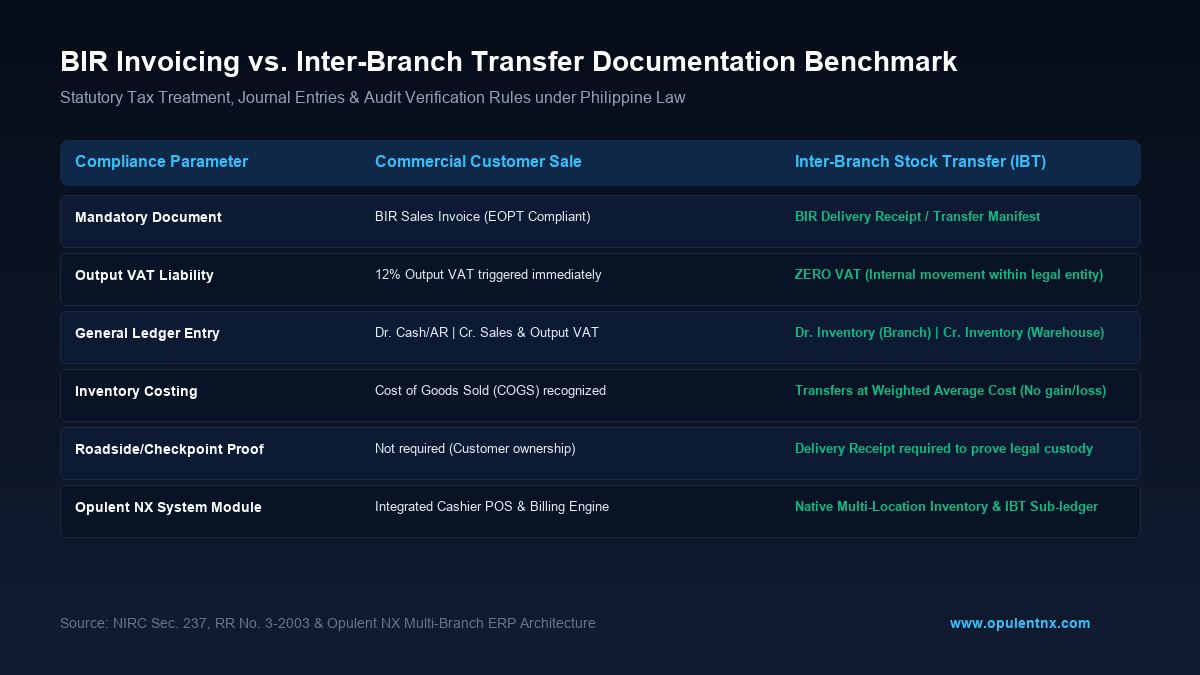
3. Key Compliance Benchmarks: Sales Invoice vs. Inter-Branch Transfer
The following statutory matrix illustrates how accounting and compliance teams must treat internal inventory movements:
| Compliance Parameter | Customer Commercial Sale | Inter-Branch Stock Transfer (IBT) |
|---|---|---|
| Governing Document | BIR Sales Invoice (EOPT Compliant) | BIR Delivery Receipt / Transfer Manifest |
| VAT Recognition | 12% Output VAT recognized immediately | ZERO VAT (Internal movement within legal entity) |
| Financial Accounting Entry | Dr. Cash/AR | Cr. Sales Revenue & Output VAT | Dr. Inventory (Branch) | Cr. Inventory (Warehouse) |
| Valuation Standard | Selling Price (SRP inclusive of margin) | Weighted Average Cost (Zero markup / zero profit) |
| BIR Audit Inspection Risk | Under-declaration of revenue (Sec. 248) | Unaccounted stock variance treated as undeclared cash sales |
4. Operational Best Practices to Prevent Multi-Branch Shrinkage
To ensure your multi-store retail chain maintains audit-proof inventory records, enforce these 3 operational controls:
- Enforce Location-Specific BIR Registration (Form 1905): In accordance with BIR regulations, every retail branch, kiosk, and warehouse location must be registered under its respective Revenue District Office (RDO) as a branch or storage facility. Your inventory management software must maintain distinct balance sheets and stock ledgers per registered RDO branch code.
- Conduct Mandatory Monthly Cycle Counts: In addition to annual statutory physical inventory counts mandated under Revenue Regulations No. 3-2003, high-velocity supermarket and retail chains must conduct weekly rotating cycle counts of top-selling SKUs to catch transfer discrepancies immediately.
- Unify Multi-Branch POS with Central ERP Ledgers: Disconnected POS software forces head office accountants to spend days manually consolidating spreadsheets at month-end. When cashiers ring up sales at individual branches, inventory deductions and inter-branch stock balances must update across the entire company network in real time.
5. How Opulent NX Powers Multi-Branch Philippine Retailers
Most point-of-sale apps in the Philippines are designed for single-store retailers. When business owners attempt to link 5, 10, or 20 branches together, these apps crumble—lacking central purchasing, inter-branch transfer protocols, and native BIR books of accounts.
Opulent NX delivers complete multi-branch retail and warehouse control:
- Native Inter-Branch Transfer & GIT Engine: Seamlessly requisition, pick, dispatch, and receive stock across multiple store locations with automated Goods-in-Transit holding accounts.
- Automated BIR Delivery Receipts: Generate pre-formatted, serialized Delivery Receipts compliant with Philippine commercial transport regulations with one click.
- Centralized Commissary & Supplier Purchasing: Aggregate stock replenishment requests across all branches into unified Purchase Orders (PO) sent directly to wholesale suppliers.
- 100% BIR CAS & EOPT Integration: All branch sales, inventory adjustments, and warehouse transfers flow directly into your computerized general ledger, sales journals, and inventory books.
Take complete control of your multi-branch inventory and eliminate stock shrinkage today. Schedule a free 15-minute live demo with our Philippine retail supply chain specialists.
See Opulent NX Live in Action
Book a free 15-minute walkthrough with our Philippine BIR & POS specialists. Start your 7-day free trial and see how we unify your cashier POS, inventory, and BIR accounting books.
- ✓ 100% BIR-Accredited POS & CAS / EOPT Compliant (From ₱1,300/mo)
- ✓ Real-Time POS to General Ledger & Multi-Warehouse Sync
- ✓ Free 7-Day Trial + 30-Min 1-on-1 Setup Call & PTU Assistance
Continue Reading: Related Philippine Compliance Guides

[…] For complete regulatory guidelines on intra-company goods transfers, see our technical breakdown of multi-branch inventory control and BIR delivery receipt compliance. […]